
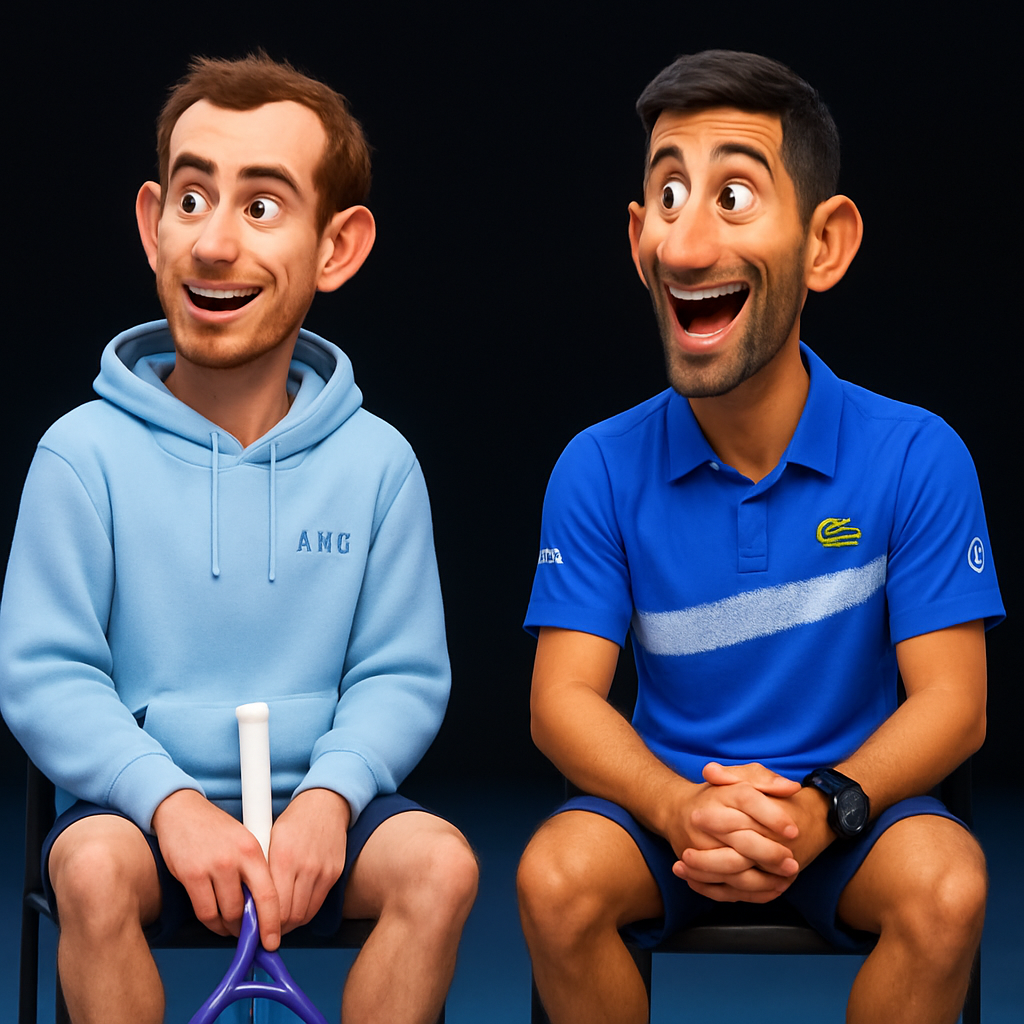
MONTE CARLO — In a stunning twist that has sent shockwaves through the tennis world, Andy Murray has revealed he was left feeling "embarrassed" on the very first day of his new, albeit temporary, job coaching his long-time rival, Novak Djokovic. The revelation came during a candid interview on the *Tennis Podcast*, where Murray detailed his experience working with the 24-time Grand Slam champion during the 2023 off-season.
The collaboration, which Murray described as a "favour" for a friend, was born out of a mutual desire for fresh perspectives. With Djokovic’s long-time coach, Goran Ivanišević, taking a brief break and Murray recovering from his own injury, the stage was set for one of the sport's most fascinating partnerships. "He asked me, and I was happy to do it," Murray stated. "I know how beneficial it is to work with someone who knows the game inside out and who you’ve shared a court with for 15 years."
The First-Day Jitters
Murray’s initial confidence, however, was quickly replaced by acute self-consciousness. Stepping onto the practice court not as a competitor but as an advisor to the world No. 1 proved to be a psychologically complex transition. "The first day I was a bit embarrassed, to be honest," Murray confessed. "You’re telling the best player maybe of all time what he should be doing on the tennis court. I was thinking, ‘Who am I to be telling Novak Djokovic how to hit a backhand or play a certain point?’"
This sense of impostor syndrome was compounded by the sheer weight of Djokovic’s achievements. Murray, a three-time Grand Slam champion himself, found the dynamic surreal. He elaborated, "You’re sitting there, and you’re analyzing his game, and you’re thinking, ‘This guy has won 24 majors. He’s arguably the greatest that’s ever played. And I’m here suggesting he try something different.’ It felt strange."
A Unique Insight into a Rival's Mind
Despite the initial awkwardness, Murray’s unique position as a former rival provided invaluable insight. Having faced Djokovic 36 times on tour, including in multiple Grand Slam finals, Murray possessed an intimate understanding of Djokovic’s patterns, strengths, and the rare chinks in his armor. This allowed their sessions to move beyond generic advice into highly specific, tactical discussions.
"Our conversations weren't about basic technique," Murray explained. "They were about match-ups, about specific players, about moments in big matches. I could say, ‘Remember when I did this against you in that final? What if you tried the opposite against someone like Alcaraz or Sinner?’ It was a dialogue between two people who have seen the game from the very top."
The focus of their work reportedly centered on several key areas where Murray believed even Djokovic could find marginal gains. Based on their discussions and subsequent observations of Djokovic’s early 2024 season, the collaboration seemed to target:
- Net Play & Transition: Sharpening approaches and volleys to capitalize on shorter balls, a tactic increasingly vital against the powerful baseliners of the Next Gen.
- Return Position Nuances: Experimenting with stance and aggression on second-serve returns against big servers.
Mutual Respect Forged in Battle
The arrangement underscored the profound mutual respect that has developed between the two champions, whose rivalry dates back to their junior days. Murray spoke with admiration about Djokovic’s professionalism and openness. "He was incredibly receptive," Murray noted. "He listens, he asks questions, he wants to understand the ‘why’ behind every suggestion. There’s a reason he’s still improving."
This experience gave Murray a new appreciation for the relentless drive that sustains Djokovic’s dominance. "Being on the inside, even briefly, you see the obsession with detail," Murray said. "It’s not just about hitting forehands for two hours. It’s about the recovery, the analysis, the constant search for a 1% improvement. It’s exhausting just to witness."
The Coach's Perspective: A New Challenge
For Murray, the stint was more than just helping a colleague; it was a fascinating foray into coaching that challenged his own understanding of the game. "It makes you watch matches differently," he reflected. "You’re not just thinking, ‘I hope he misses.’ You’re thinking about structure, about patterns, about solutions. It’s a completely different part of your brain."
The experience has also fueled speculation about Murray’s future career path once he hangs up his racket. While he was quick to dismiss the idea of a full-time coaching role in the immediate future, he didn't rule it out. "I enjoyed the problem-solving aspect of it," he admitted. "Seeing the game from that side was incredibly stimulating."
A Partnership That Redefines Rivalry
The image of Andy Murray, the tenacious Scot who broke the "Big Four" duopoly, now advising Novak Djokovic, the most successful of them all, is a powerful symbol of how elite sport evolves. It moves beyond the binary of friend and foe into a more nuanced space of shared experience and ultimate respect. Their rivalry, once defined by grueling baseline battles and Grand Slam heartbreak for Murray, has matured into a partnership of minds.
The tennis world has taken keen note. Djokovic began his 2024 season with a commanding run to the Australian Open semifinals, displaying sharpened net play and tactical variety that many attributed to his off-season work. While Murray’s role was just one piece of Djokovic’s preparation, its impact appears tangible. As one analyst put it, "Who better to help Djokovic find an edge than the man who spent a career searching for edges against him?"
In the end, Murray’s initial embarrassment gave way to a sense of contribution. "Once I got over myself on that first day, it was brilliant," he concluded. "To be able to share what I’ve learned over my career with someone like Novak, and to see him actually consider it and apply it, that was a special experience. It’s not something many people get to do." This unique chapter between two legends reminds us that in the highest echelons of sport, the greatest competitors can also become the most insightful teachers.