
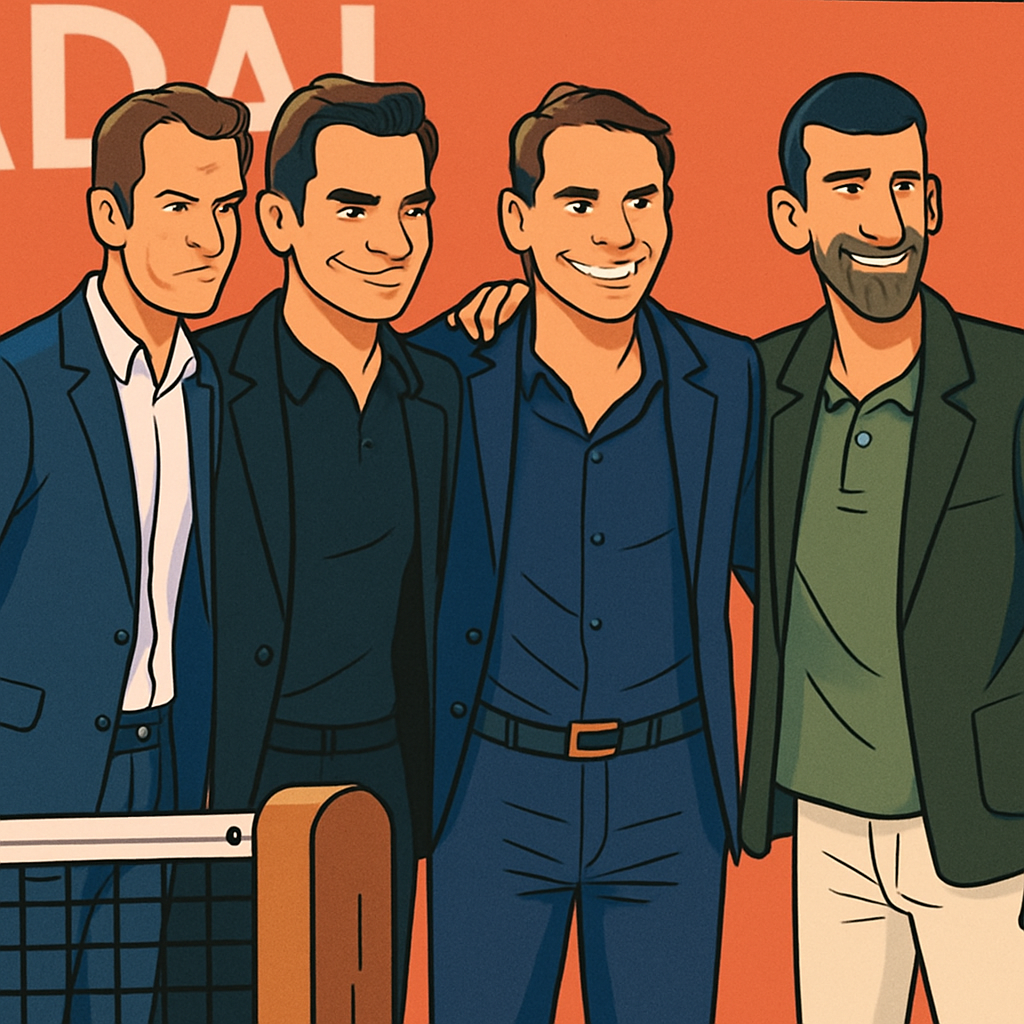
LONDON — In the pantheon of men's tennis, the 'Big Four' is a term etched into history, representing an era of unprecedented dominance shared by Roger Federer, Rafael Nadal, Novak Djokovic, and Andy Murray. While the first three ascended to almost mythical status in their rivalry-turned-friendship, Murray has often been viewed as the outsider of the quartet. In a candid revelation, the three-time Grand Slam champion has now explained the professional barrier that prevented him from ever being truly "friends" with his legendary rivals, even as they extend social invitations in retirement.
The Unspoken Wall of Competition
Speaking on the BBC's Tailenders podcast, Murray peeled back the curtain on the dynamics at the very top of the sport. He described a necessary, self-imposed distance he maintained from Federer, Nadal, and Djokovic during their peak competing years. For Murray, the intensity of the battle and the sheer will to win created an insurmountable wall. "I didn't really want to be friends with them," Murray stated bluntly. "I found it hard to be super close with them because when I was on the court, I wanted to beat them."
This mindset wasn't born out of personal animosity but from a deep-seated competitive philosophy. Murray feared that forging close personal bonds could dilute the ferocity needed to challenge players of such calibre. He saw their on-court personas—Federer's icy elegance, Nadal's gladiatorial intensity, Djokovic's relentless precision—as entities he needed to conquer, not humanize over a friendly dinner. The psychological edge, he believed, was paramount.
A Contrast in Camaraderie
This stance highlights a stark contrast with the evolving relationship between Federer, Nadal, and Djokovic. While their rivalries were famously fierce, a mutual respect has blossomed into a visible camaraderie in their later years. They have shared countless on-court embraces, participated in joint exhibition events for charity, and publicly praised each other's achievements. Djokovic has often spoken of the "beautiful friendship" and "brotherhood" that developed, particularly through shared experiences like the Laver Cup and the ATP Player Council.
Murray acknowledged this shift, noting that the dynamic has changed now that he and his rivals are in the twilight of their careers. "Now, things are a little bit different. I got a message from Rafa the other day because we are going to do a charity match... and I would love to get to know them better," he revealed. The invitation signifies a thawing of the professional ice, an opening for connection now that the daily battle for supremacy has faded.
The Psychological Toll of the Chase
Murray's explanation sheds light on the unique psychological burden he carried. While Federer, Nadal, and Djokovic were trading the world No. 1 ranking amongst themselves, Murray was the perennial challenger, often the lone figure trying to crash their party. This position required a different kind of mental fortitude. To humanize his opponents, to see them as friends, could be perceived as a form of surrender to their dominance. His approach was one of necessary isolation, a tool to fuel the belief that he could topple them.
This isn't to say relationships were purely hostile. There has always been a bedrock of respect. Murray has consistently hailed the trio as the greatest to ever play, and they have reciprocated with praise for his resilience and Olympic triumphs. The distance was professional, not personal. As Murray put it, their interactions were largely confined to the functional: "When we saw each other, we would speak and be polite and everything, but it wasn't like we were going out for dinner or things like that."
The Legacy of the "Big Four"
The term "Big Four" itself is a testament to Murray's immense impact. He broke the duopoly of Federer and Nadal, reached world No. 1, and won three Grand Slams and two Olympic gold medals in the sport's most competitive era. Yet, his career trajectory—marred by a severe hip injury—and his different approach to rivalry have cemented his distinct place within the group. His revelation provides a crucial footnote to the era, illustrating that there were two distinct relationship models at play:
- The Triad: Federer, Nadal, and Djokovic, whose epic battles forged a unique, public bond of mutual admiration and eventual friendship.
- The Lone Wolf: Murray, who used a deliberate distance as a psychological weapon in his quest to compete with them.
Both approaches were valid and born from the same source: an all-consuming desire to win. For the trio, camaraderie became a refuge from the pressure. For Murray, isolation was the fuel. His choice likely made his successes—like the historic 2012 US Open win or the 2013 Wimbledon triumph—even sweeter, as they were victories over not just opponents, but perceived giants.
A New Chapter of Connection
Now, with the landscape altered, Murray appears open to rewriting the script. Nadal's invitation for a charity match is a symbolic passing of the torch from intense rivalry to respected legacy. The shared experience of navigating retirement, injuries, and life beyond the tour can form a new basis for connection. "I would love to get to know them better," Murray's statement is a poignant acknowledgment of what was sacrificed at the altar of competition.
In the end, Andy Murray's candid explanation adds a profound layer of understanding to one of sport's greatest eras. It reminds us that at the pinnacle of elite competition, relationships are often strategic. His inability to be "friends" with Federer, Nadal, and Djokovic wasn't a failure of character, but a calculated choice in a decades-long war for tennis immortality. The invitation now sent represents a chance for a different, perhaps more human, kind of victory—one of connection forged not in battle, but in the shared peace of a legendary career's aftermath.