
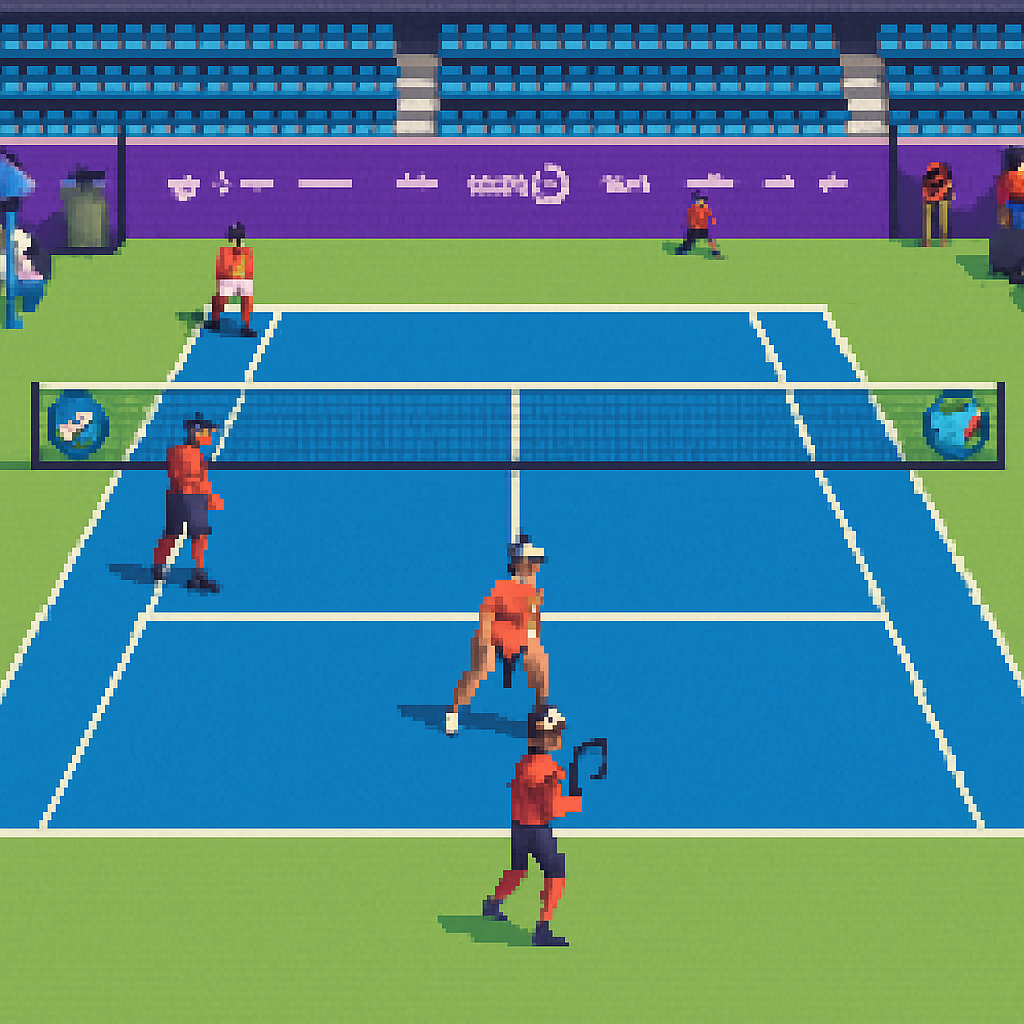
NEW DELHI — A routine professional tennis match in India descended into scenes of pure pandemonium this week, as viral footage captured the terrifying moment players and officials dropped their rackets and sprinted for their lives, fleeing the court to escape a sudden and dangerous invasion.
The incident occurred during a men's doubles match at the Bengaluru Open, an ATP Challenger Tour event, on Wednesday. What began as a high-stakes sporting contest between the Indian pair of Rithvik Choudary Bollipalli and Niki Kaliyanda Poonacha and their opponents, France's Maxime Janvier and Belgium's Gauthier Onclin, was abruptly shattered by an unexpected and unwelcome guest.
The Uninvited Court Crasher
With the match finely poised, a large, aggressive swarm of bees descended onto Court 1 of the Karnataka State Lawn Tennis Association (KSLTA) stadium. The insects, likely attracted by the bright lights and activity, buzzed menacingly around the players, who initially tried to swat them away before realizing the severity of the situation.
The now-viral video shows the precise moment chaos erupted. French player Maxime Janvier is seen frantically waving his arms before decisively hurling his racket to the ground and sprinting towards the exit. His partner, Gauthier Onclin, and the Indian duo immediately followed suit, abandoning all equipment as they bolted for the safety of the tunnel.
The chair umpire and line judges were not far behind, with one official dramatically diving over the net in his haste to escape. The footage, which has amassed millions of views across social media platforms, presents a surreal sight: a pristine tennis court littered with abandoned rackets, towels, and water bottles, silently presided over by a buzzing cloud of insects. "One moment it's a high-level professional match, the next it looks like a scene from an action movie," one social media user commented.
A Sting in the Tale for the Tournament
Tournament organizers and staff were forced to act quickly. Play was suspended for nearly two hours as professional beekeepers were summoned to the venue to safely disperse the swarm. The solution, while effective, added another layer of surrealism to the event. Beekeepers in protective suits calmly worked to relocate the bees while players and fans watched from a safe distance.
Speaking after the incident, Indian player Niki Poonacha described the fear of the moment. "We were just trying to focus on the next point, and then suddenly there was this loud buzzing all around us. At first it was a few, then within seconds it was a full swarm. We didn't think, we just ran. It was pure instinct," he said.
His partner, Rithvik Bollipalli, highlighted the absurdity of the situation for a professional athlete. "You train for years for these moments, you prepare for every scenario—heat, wind, pressure—but nobody prepares you for a bee invasion. Your mind goes blank except for 'get out.'"
Not the First Time: Bees and Sporting Events
While dramatic, bee invasions at sporting events are not unheard of. The incident in Bengaluru joins a curious list of similar disruptions:
- 2023 BNP Paribas Open, Indian Wells: A bee swarm famously delayed a quarterfinal match between Carlos Alcaraz and Alexander Zverev, with the insects covering the camera lens.
- 2019 Caribbean Premier League: A cricket match in Trinidad was halted by a massive bee swarm.
- 2021 African Football Cup of Nations Qualifier: A match between Senegal and Congo was stopped twice due to bee attacks.
Experts suggest that such swarms are often not inherently aggressive but are instead "absconding" swarms—a large group of bees, including a queen, leaving an established hive to find a new home. They are attracted to certain scents, carbon dioxide, and bright lights, making a night-time tennis court under floodlights a potential target during their migration.
The Match Must Go On
Once the beekeepers had safely removed the swarm, officials faced the logistical challenge of resuming the tournament. The disrupted doubles match was eventually completed, with the French-Belgian pair, Janvier and Onclin, managing to regroup and secure a victory with a score of 7-6(4), 6-3. The show, as they say, went on.
Tournament director Sunil Yajaman praised the swift response of the staff and the understanding of the players. "The safety of our players, officials, and fans is paramount. While it was an unprecedented situation, our security and venue teams acted promptly with the help of local experts to resolve it. We are grateful no one was hurt," he stated in an official release.
The ATP Challenger Tour acknowledged the incident with a touch of humor on its social media channels, posting the viral clip with the caption, "When you're fully locked in during your match... Literally nothing can stop you. Except maybe this." The lighthearted response helped turn a frightening moment into a globally shared, if bizarre, tennis anecdote.
A Viral Moment with a Lasting Buzz
Beyond the immediate disruption, the Bengaluru bee invasion has sparked wider conversations. It served as a vivid reminder of nature's unpredictable power to interrupt even the most meticulously planned human activities. For the players involved, it will undoubtedly become a career story they recount for years to come.
The incident also showcased the athletes' human side. Stripped of their competitive personas, they reacted with the same primal fear anyone would, providing a relatable and humorous contrast to their usual image of focused intensity. As one tennis journalist noted, "It's a reminder that athletes are people first, and nobody likes being stung by a bee."
While the Bengaluru Open continued successfully, the footage ensures its place in sporting folklore. The image of world-class athletes in full flight, not from a blistering forehand but from a buzzing insect swarm, perfectly encapsulates the chaos and unpredictability that sometimes defines live sport. The match had a literal sting in the tail, but for the global audience, it provided an unforgettable moment of viral, shared astonishment.