
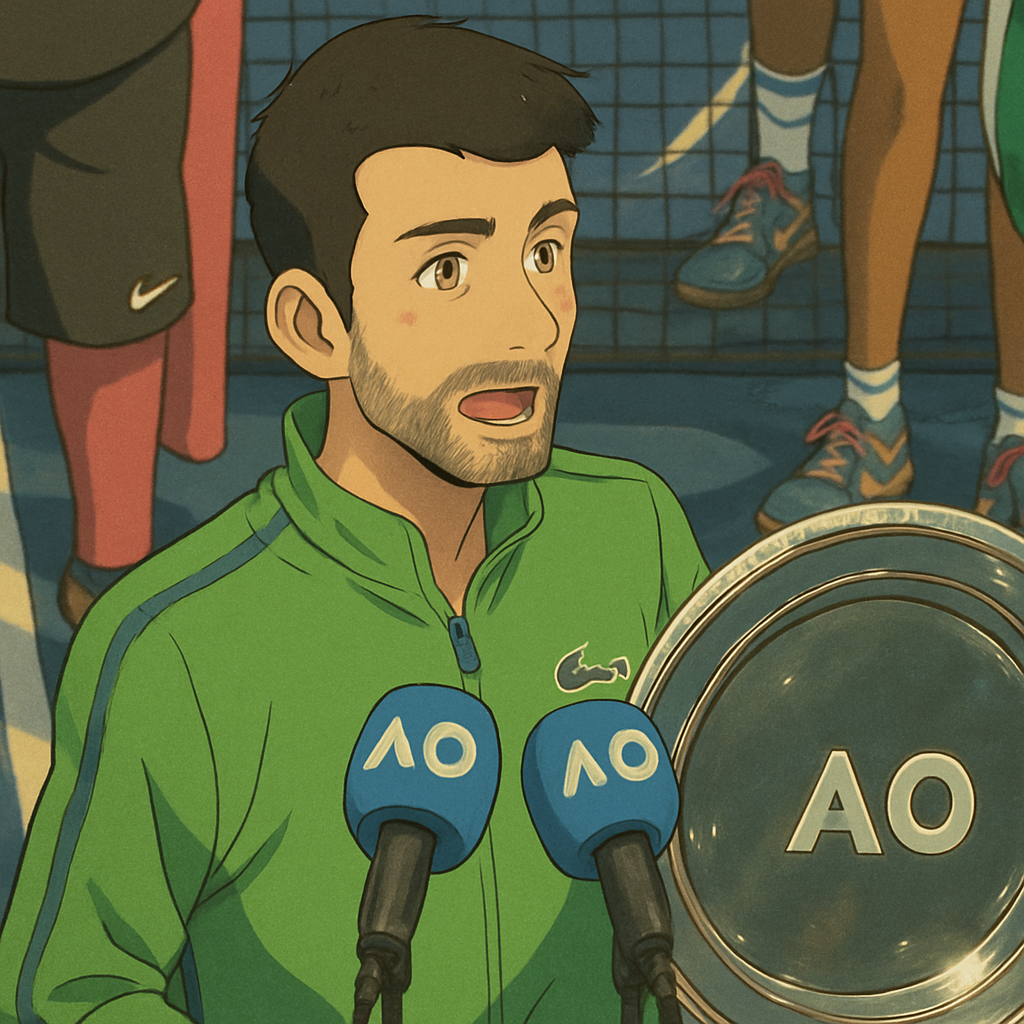
MELBOURNE — In the hushed, cavernous atmosphere of Rod Laver Arena, a seismic shift in the tennis landscape felt palpable. For the first time in 2,195 days, Novak Djokovic walked off the court at the Australian Open not as champion, but as a finalist, defeated in straight sets by a brilliant Jannik Sinner. Yet, the 7-6(3), 6-3, 6-3 scoreline that ended his 33-match winning streak at Melbourne Park was only the prelude to a moment that sent ripples through the sport. Minutes after the loss, the 24-time Grand Slam champion dropped his most explicit hint yet that the end of his legendary career is a reality he is beginning to confront.
The post-match ceremony, typically a coronation for Djokovic in Australia, became a platform for raw reflection. Holding his runner-up plate, the 36-year-old Serb addressed the crowd with a tone of poignant finality. "This tournament has been the most special tournament of my life, and it still is," he began, before adding a caveat that stunned the tennis world. "I just have to see how I go here in the future, whether I come back. I don't know. I don't know if this is the beginning of the end or just the beginning."
The Unraveling of an Australian Fortress
Djokovic’s defeat was not merely a loss; it was a systematic dismantling. Jannik Sinner, the 22-year-old Italian who had beaten him twice in their last three meetings, executed a flawless game plan. He served with immense power and precision, denying Djokovic a single break point opportunity—a statistical anomaly in a Djokovic match, especially in a best-of-five-set Grand Slam final. The Serbian maestro, usually a predator on return, was rendered a spectator for large stretches. His movement, while still elite, seemed a half-step slow, and his trademark mental fortitude wavered under Sinner’s relentless pressure.
The cracks had been visible throughout the fortnight. Djokovic labored through four-set battles in the early rounds, appearing uncharacteristically vulnerable and battling an illness. He acknowledged in his press conference that this was "not my best Grand Slam tournament in terms of my performance." Yet, the tennis world has grown accustomed to him finding a way. This time, against a younger, fearless opponent playing the match of his life, the magic eluded him.
Reading Between the Lines of Retirement
It was in the post-match press conference, however, where Djokovic’s comments transcended typical disappointment and ventured into existential territory. When pressed to elaborate on his on-court remarks about the future, he offered a startlingly candid assessment. "I still have high hopes and goals for other Slams, for Olympics, and other tournaments," he stated, before immediately tempering that ambition with reality.
"But I'm aware that at this stage of my life and career, every Grand Slam victory or final could be the last one," Djokovic continued. "That's the kind of approach I have now. I don't have the endless runway ahead of me anymore. I'm aware of that." This acknowledgment of a finite timeline is a profound shift for an athlete who has long spoken of chasing records and playing into his 40s.
He elaborated on the compounding challenges that come with age, which include:
- Physical Recovery: The increasing difficulty of bouncing back from long, grueling matches.
- Motivational Balance: Finding the "right emotion" and "right intensity" for every tournament.
- Personal Priorities: The growing pull of family life with his wife and two young children.
The New Guard Has Officially Arrived
Djokovic’s hints cannot be divorced from the context of his defeat. Jannik Sinner’s victory is not an isolated incident but the culmination of a trend. Carlos Alcaraz (20) has already wrestled a Wimbledon title from him. Sinner (22) now has an Australian Open. The "Big Three" era, which Djokovic has ruled almost single-handedly in recent years, is unequivocally giving way to a "New Big Three" of Alcaraz, Sinner, and Daniil Medvedev. The physical and tactical challenge they present is a daily, grinding pressure that takes a toll.
Tennis legend Jim Courier, analyzing for Channel Nine, pinpointed the significance of the moment. "What we heard from Novak tonight was the most vulnerable and contemplative he has ever been about his future," Courier said. "He's always spoken in terms of 'when I'm done,' but tonight he spoke in terms of 'if I come back.' That's a seismic shift in language from a man who has treated this court as his personal property."
What Does the Road Ahead Look Like?
Djokovic was careful not to announce any concrete plans. He confirmed his intention to play the upcoming French Open, Wimbledon, and the Paris Olympics, where he will desperately seek the one major honor missing from his resume: Olympic singles gold. However, he framed even these goals with a new layer of uncertainty. The relentless pursuit of history, which has fueled him for two decades, now seems balanced against a desire for peace and a life beyond the baseline.
His long-time coach, Goran Ivanišević, offered a more tempered view, suggesting the comments were born of fresh disappointment. "He is the ultimate professional and competitor. When the dust settles, he will analyze, he will recover, and he will find new motivation," Ivanišević said. "But he is also a human being and a father. He is thinking about more than tennis now."
Conclusion: The Beginning of the End?
Novak Djokovic did not announce his retirement on the court in Melbourne. He may yet add to his historic tally of 24 Grand Slam titles. But for the first time, he publicly and poignantly opened the door to the idea that his immortal tenure at the top of tennis has an expiration date. The loss to Sinner signaled a changing of the competitive guard. His words that followed signaled a potential changing of his personal guard—from the single-minded champion to a man weighing legacy against life.
The tennis world is left to ponder his own question: Was this the beginning of the end, or just a new beginning? Either way, a veil of inevitability has been lifted. Every match Novak Djokovic plays from now on will be watched not just for victory, but for a glimpse of a finale. The greatest champion in the history of the men's game has, for the first time, allowed us to see the horizon.