
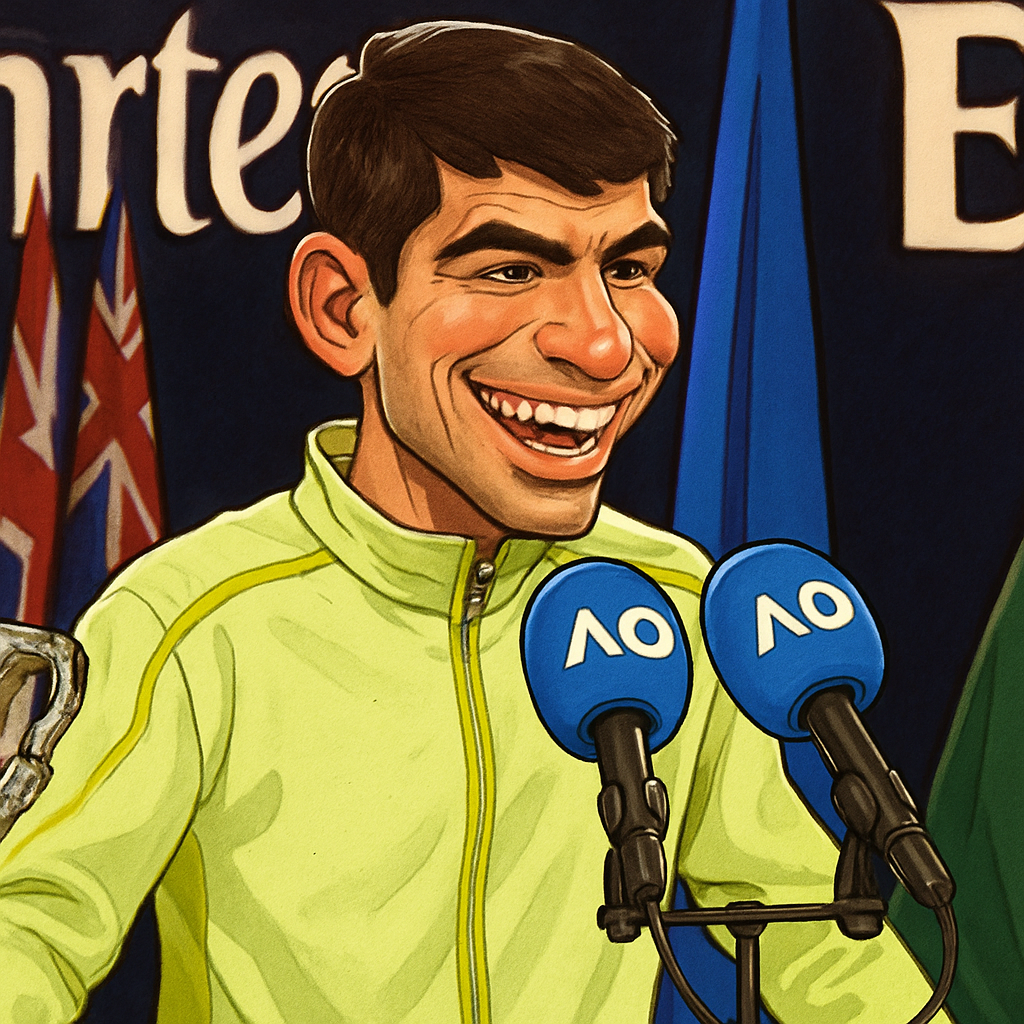
MELBOURNE — In the heart of a sweltering Australian summer, a new king was crowned. Carlos Alcaraz, the dynamic Spaniard whose every shot crackles with youthful exuberance, has conquered the final frontier of his young career, defeating Daniil Medvedev in a five-set epic to claim his first Australian Open title. With this 3-6, 6-3, 6-3, 6-7(5), 6-4 victory, Alcaraz not only secured his third Grand Slam trophy but also sent a thunderous, unspoken message to the absent Novak Djokovic: the chase for tennis supremacy is officially a multi-man race, and the future is arriving ahead of schedule.
The narrative entering the tournament was dominated by Djokovic’s quest for an unprecedented 11th Australian Open crown and a 25th major overall. Yet, a semifinal upset at the hands of Jannik Sinner shattered that script, opening the door for a new champion. Alcaraz, who missed last year's event due to injury, stormed through that door with a blend of breathtaking power, delicate touch, and a competitive spirit that belies his 20 years. In the final, he stared down a one-set deficit against the relentless Medvedev, recalibrated his aggressive tactics, and ultimately outlasted the Russian in a grueling four-hour, 42-minute marathon on Rod Laver Arena.
A Message Forged in Melbourne's Crucible
While Djokovic was not across the net, his presence loomed large over the fortnight and the final result. For years, the "Big Three" era, now distilled primarily to Djokovic's enduring dominance, has defined the sport. Alcaraz, under the guidance of coach Juan Carlos Ferrero, has been positioned as the most credible heir apparent. His Wimbledon victory over Djokovic last summer was a seismic statement, proving he could dethrone the king on the grandest stages. This Australian Open win, however, carries a different, perhaps more profound, weight. It demonstrates a critical evolution in Alcaraz's game: the maturity to win a major where he was not at his absolute blistering best.
Throughout the tournament, Alcaraz navigated tricky moments. He dropped sets, faced different styles, and had to problem-solve on the fly. His post-final comments revealed a player acutely aware of the symbolic significance of his triumph. "Winning here, completing three different Grand Slams, it means a lot to me," Alcaraz said. "It shows the work we are doing, the variety in my game to adapt to every surface. This is the level you must have to fight with the best in history."
The phrase "the best in history" is not a vague platitude. In the context of the current landscape, it is a direct reference to Djokovic. By winning on the hard courts of Melbourne—Djokovic's most impregnable fortress—Alcaraz has effectively claimed territory. He now holds major titles on grass (Wimbledon), clay (Roland Garros), and hard court (US Open and now Australia). This versatility, so reminiscent of the all-surface mastery of Djokovic, Roger Federer, and Rafael Nadal, is the foundation of a true all-time great career.
The Alcaraz Blueprint: More Than Just Power
What makes Alcaraz such a potent threat to Djokovic's continued reign is the multifaceted nature of his game. He is not a one-dimensional power baseliner. His arsenal is a mesmerizing cocktail of styles that forces opponents out of their comfort zones. Against Medvedev, a human backboard, Alcaraz masterfully mixed his approach:
- Relentless Aggression: Crushing forehands to shorten points and dictate rallies.
- Strategic Drop Shots: Dragging the deep-standing Medvedev forward, a tactic that yielded crucial points.
- Net Proficiency: He won 55 of 74 net approaches, showcasing confidence and soft hands.
- Mental Fortitude: Recovering from losing a tight fourth-set tiebreak to break Medvedev immediately in the fifth.
This tactical flexibility is what coaches and pundits believe is necessary to challenge Djokovic consistently. "Carlos doesn't have a plan B; he has plans B through Z," former champion Jim Courier noted during the broadcast. "He can win a point in so many different ways, and that unpredictability is a nightmare for anyone, including Novak."
The Numbers Behind the Narrative
The statistics from Alcaraz's Australian Open run underscore his all-court dominance and rising status. He led the tournament in several key aggressive metrics, including forehand winners and net points won. Perhaps most tellingly, at 20 years and 261 days, he became the youngest man in the Open Era to win Grand Slam titles on three different surfaces. He also joins an elite group of players to have won three or more majors before turning 21, a list that includes Bjorn Borg, Mats Wilander, and his idol, Rafael Nadal.
The Road to the Summit
For Djokovic, who has spoken openly about using Grand Slam records as his primary motivation, Alcaraz's rapid ascent adds a compelling new layer to his quest. The Serbian champion has repeatedly praised Alcaraz, calling him a "complete player" and the fusion of the best qualities of the "Big Three." This Australian Open result transforms that respect into a clear and present danger. The head-to-head stands at a tantalizing 2-2 in Slams, with each winning a final against the other. The stage is set for a defining rivalry for the next phase of tennis history. The upcoming clay and grass court seasons, culminating at Roland Garros and Wimbledon, now carry the weight of a potential No. 1 ranking battle and a direct clash for the mantle of the sport's top player.
Alcaraz, for his part, remains publicly deferential but privately driven. When asked about Djokovic after the final, he stated, "Novak is the best in the world, the one we are all chasing. To be able to compete with him, to win tournaments like this, you have to keep improving every part of your game. I know the challenge; I am ready for it."
Conclusion: A New Era Dawns
Carlos Alcaraz's victory at the 2024 Australian Open was more than a coronation; it was a declaration. By capturing the title in Djokovic's absence but, more importantly, by demonstrating the complete, resilient, and champion-caliber game required to win on any surface, he has issued the perfect message. The message is not one of disrespect, but of inevitability. It signals that the pathway to future Grand Slam glory will no longer be a solitary march for Novak Djokovic, but a demanding duel against a generational talent who possesses the tools, the temperament, and now the proven pedigree on all surfaces to stand as an equal. The baton is not yet passed, but the hand reaching for it is steady, strong, and crowned with laurels from Melbourne Park.