
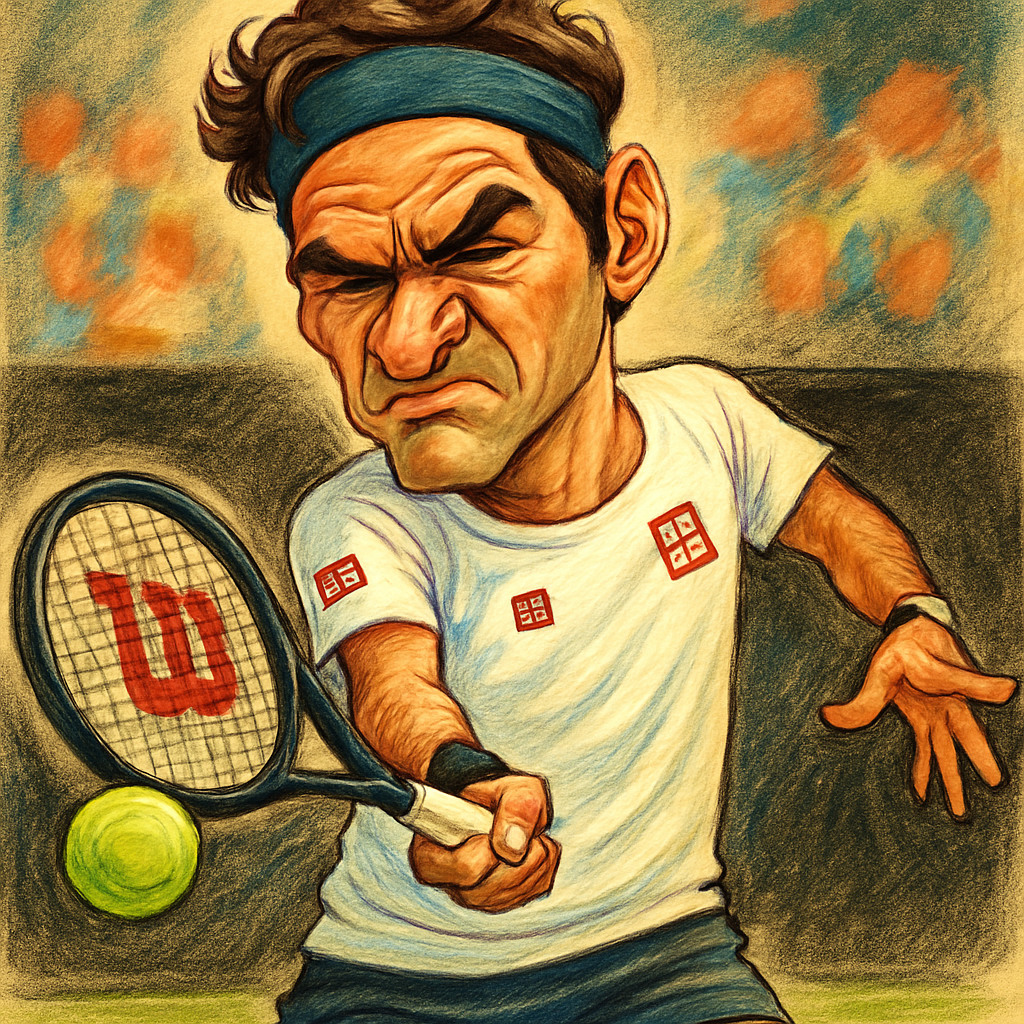
PARIS — In the relentless, power-driven landscape of modern women's tennis, where baseline bombardments are the norm, a singularly graceful anomaly has emerged. Her name is Elena Rybakina, and her game—a symphony of effortless power, balletic movement, and serene composure—has drawn comparisons to the greatest of all time. So much so that the sport's current dominant force, Iga Swiatek, has bestowed upon her the ultimate compliment, calling Rybakina "the women's Roger Federer."
This isn't mere hyperbole. Swiatek, a four-time Grand Slam champion and the world's top-ranked player for most of the past two years, made the comparison in the context of a specific, formidable challenge. She identified Rybakina as the player whose game most disrupts her own rhythm and presents a unique puzzle. In doing so, Swiatek pinpointed what many fans and pundits have observed: Rybakina possesses a Federer-esque quality of making the extraordinarily difficult look simple, of imposing her will not with visible strain, but with clean, efficient, and devastatingly effective shot-making.
The Federer Blueprint in a Modern Frame
Roger Federer's legacy is built on a foundation of fluid, aggressive tennis that seemed to float above the fray. His game was defined by a potent first serve, a lethal and versatile forehand, sublime movement that appeared gliding rather than grinding, and an unshakeable, ice-cool demeanor under pressure. Elena Rybakina, the 2022 Wimbledon champion, mirrors this blueprint in a distinctly modern, 6-foot frame. Her weapons are not just powerful; they are delivered with a calm, almost detached, precision that can unnerve opponents.
The core of Rybakina's Federer-like impact lies in her serve and first-strike capability. Standing tall, she unleashes one of the most formidable serves on tour—a weapon that earns free points and immediately puts her on the front foot. Much like Federer, she follows this up not with grinding rallies, but with a decisive forehand or a crisp volley. Her game is built on economy: shortening points, controlling the center of the court, and denying her opponent the rhythmic, extended exchanges they crave. This is precisely the style that has given Iga Swiatek, a master of rhythm and heavy topspin, consistent trouble.
Swiatek's Kryptonite: A Matchup Analysis
The head-to-head record tells a compelling story. While Swiatek boasts a commanding lead over most of the tour, her battles with Rybakina are tightly contested. As of mid-2024, Rybakina is one of the few players with a positive winning record against the Polish star in significant matches, having beaten her multiple times on big stages. Their clashes are less about dramatic momentum swings and more about Rybakina's ability to impose a game that neutralizes Swiatek's greatest strengths.
Swiatek thrives on time—time to set up her heavy forehand, time to run around her backhand, time to construct points with her superior movement. Rybakina systematically takes that time away. Her serve bombs push Swiatek back. Her flat, penetrating groundstrokes, particularly off the backhand wing, skid through the court with low bounce, preventing Swiatek from getting into her preferred hitting zone. The tactical simplicity is Federer-like: dominate with the first serve, control with the first return, and finish at the first opportunity.
Swiatek herself has articulated the challenge. After a loss, she noted, "For sure, her game is putting a lot of pressure on me. She has a great serve, so it's hard to break her. And she's playing really fast from the baseline, so it's hard to do anything with your speed or with your spins." This admission highlights how Rybakina's "Federer game" acts as a tactical counter to the modern, spin-heavy baseline game that Swiatek has perfected.
Beyond the Stats: The Demeanor
The comparison extends beyond technical prowess into the psychological realm. One of Federer's most legendary traits was his unflappable composure. Whether facing break point or championship point, his demeanor rarely changed. Rybakina exhibits this same stoic calm. Nicknamed the "Ice Queen," she displays minimal emotion on court. There are no fiery screams, no dramatic fist-pumps—just a focused, business-like execution of her game plan.
This mental fortitude is a weapon in itself. Against a fighter like Swiatek, who feeds off energy and momentum, Rybakina's calm can be disarming. It creates an atmosphere where the match feels like it is being played entirely on Rybakina's terms and at her preferred, rapid tempo. Her post-match interviews often reflect this, downplaying highs and lows with a Federer-esque grace. "I was just focused on my game," is a typical, understated Rybakina summation of a monumental victory.
The WTA's New Paradigm and Future Rivalry
The emergence of a "women's Federer" in Rybakina signals an exciting evolution for the WTA Tour. For years, the tour was defined by powerful baseliners. Now, a clear stylistic dichotomy is forming at the top, reminiscent of the classic rivalries in men's tennis:
- The Master of Spin & Rhythm: Iga Swiatek, with her heavy topspin, relentless movement, and emotional fire.
- The Master of Flat Power & Composure: Elena Rybakina, with her serve-first, first-strike, ice-cool approach.
This contrast is the recipe for a defining rivalry. Just as Federer's artistry was often challenged by the relentless power and topspin of Rafael Nadal, Swiatek's dominance is being tested by Rybakina's streamlined aggression. Their matches are becoming must-watch events, tactical chess matches played at bullet speed. It’s a rivalry that elevates the sport, showcasing two distinct, elite pathways to victory.
Conclusion: A Legacy in the Making
When Iga Swiatek, the standard-bearer of her generation, names Elena Rybakina the "women's Roger Federer," it is a profound acknowledgment of a unique and transcendent talent. It recognizes that Rybakina's game carries the hallmarks of sporting greatness: simplicity, efficiency, power, and poise. She has found a formula that not only wins major titles but does so in a way that troubles the very best.
While Rybakina's career is still unfolding, the Federer comparison is less about guaranteed Grand Slam totals and more about stylistic identity and impact. She has brought a classic, attacking elegance back to the forefront of the women's game. In an era of brute force, Rybakina is the reminder that there is immense, crowd-pleasing power in precision and calm. The WTA Tour has indeed found its own Roger Federer, and in doing so, it may have found the perfect foil to craft one of tennis's next great rivalries.