
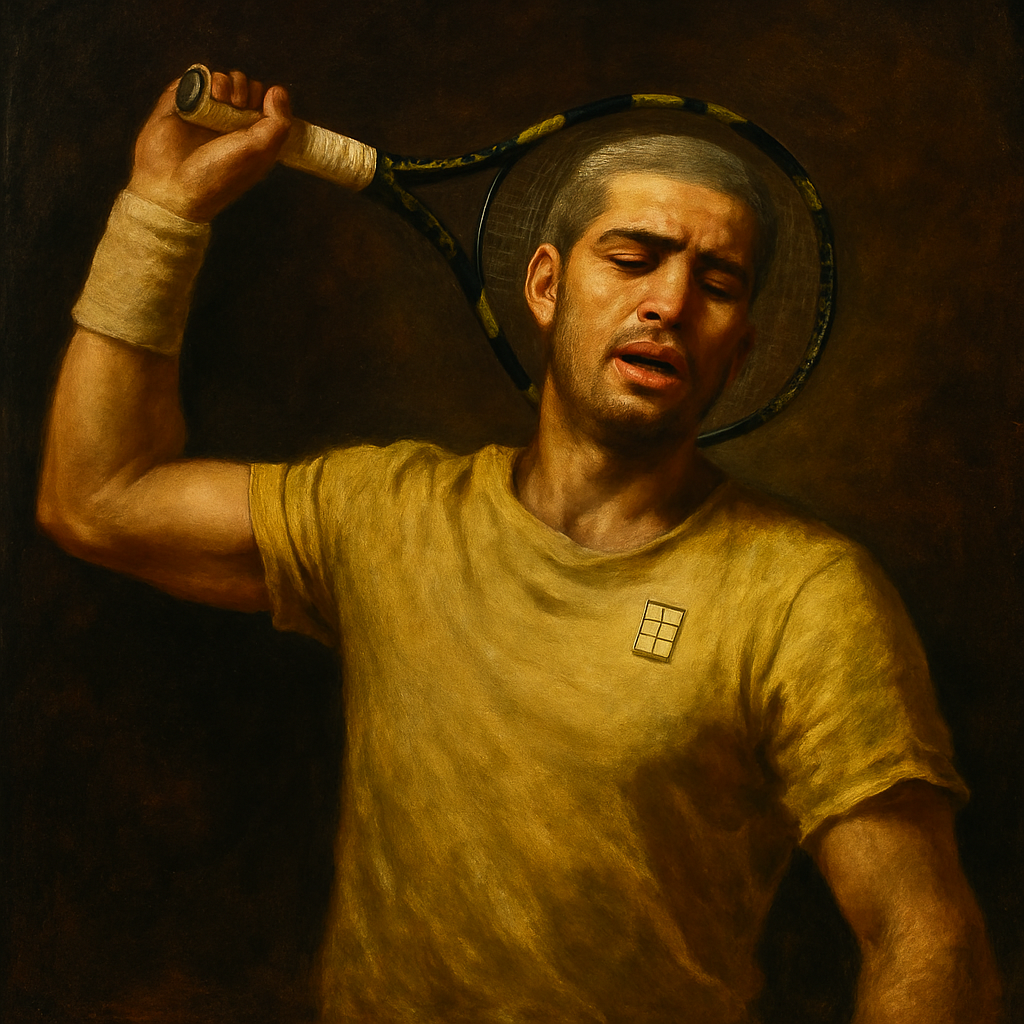
PARIS — The normally relaxed atmosphere of a post-match press conference turned tense at the 2023 Paris Masters when Kazakhstan's Alexander Bublik delivered a sharp retort to a journalist who attempted to draw a comparison between him and the young Spanish sensation, Carlos Alcaraz. The exchange, which has since gone viral on social media, highlighted the fine line journalists walk between analysis and perceived disrespect when questioning professional athletes.
The Awkward Exchange
The incident occurred after Bublik secured a hard-fought 6-2, 2-6, 6-3 victory over Frenchman Alexandre Müller, advancing to the second round of the prestigious ATP Masters 1000 event. The initial questions focused on the match itself before a reporter shifted the topic, asking Bublik to comment on a perceived similarity in his playing style to that of the then-World No. 2. The reporter suggested that both players share a certain "unpredictability" and a propensity for hitting "tweeners" – the flashy, between-the-legs shots that electrify crowds.
Bublik, known for his own mercurial talent and powerful serve, did not take kindly to the comparison. He immediately shut down the premise of the question with a mixture of bemusement and bluntness. "Please don't compare me to Carlos Alcaraz," he stated firmly, pausing for effect. "He's a two-time Grand Slam champion. He's fighting for the No. 1 spot. I'm fighting to stay in the top 50. There is no comparison. It's disrespectful to him."
The room fell into an uncomfortable silence. The reporter attempted to clarify, emphasizing that the comparison was meant only in the context of their shared flair for the spectacular. Bublik, however, was not swayed. He reiterated his point, framing it as a matter of respect for Alcaraz's achievements, which at that point already dwarfed those of most players on tour, let alone Bublik's own respectable but less decorated career.
Context: The Weight of the Alcaraz Name
To understand the force of Bublik's reaction, one must consider the stratospheric rise of Carlos Alcaraz. By the autumn of 2023, the young Spaniard had already cemented his place among the tennis elite. His accomplishments included:
- Winning the 2022 US Open, becoming the youngest World No. 1 in ATP history.
- Capturing the 2023 Wimbledon title in an epic final against Novak Djokovic.
- Winning multiple Masters 1000 titles and establishing a fierce rivalry with the sport's established giants.
For Bublik, a player whose career-high ranking was No. 25 and who had yet to progress beyond the fourth round of a major, being likened to a player of Alcaraz's caliber felt less like a compliment and more like an inaccurate and trivializing comparison. His response was a defense of the hierarchy and respect within the sport. He was, in effect, acknowledging the gulf in class and achievement, a rare and candid admission in the hyper-competitive world of professional tennis.
Bublik's Unique Position on Tour
Alexander Bublik is one of the most entertainingly enigmatic figures on the ATP Tour. Possessing a rocket-powered serve and a toolbox of trick shots, he is capable of beating anyone on his day, but he has also been open about his complicated relationship with the sport. He has famously stated that he doesn't love tennis and views it as his job, a refreshingly honest perspective in a world often dominated by clichés.
This context is crucial. Bublik's rejection of the Alcaraz comparison wasn't just about humility; it was also a reflection of his own self-awareness. He understands his game and his place in the ecosystem of the tour. To be compared to a player whose entire existence seems dedicated to achieving tennis immortality likely struck him as not only inaccurate but also as a misunderstanding of his own persona and career trajectory.
The Broader Issue of Player Comparisons
The awkward interview in Paris touches on a recurring theme in sports journalism: the reliance on comparisons. While it is a natural instinct for analysts and fans to contextualize a player's style by referencing a star, it can often be a lazy or frustrating line of questioning for the athletes themselves. It implicitly places one player in the shadow of another, potentially diminishing their own unique identity and struggles.
Bublik’s reaction was a powerful pushback against this trend. He forced the room to see him as Alexander Bublik, not as a "discount Alcaraz" or "Alcaraz-lite." He demanded that his career, with its own set of challenges and triumphs, be evaluated on its own terms. In a later interview, when asked about the viral moment, Bublik expanded on his thoughts, though he remained characteristically blunt. "I just call it as I see it. He is a great champion. I am a journeyman. It's simple."
Reaction from the Tennis World
The clip of the interview spread quickly across platforms like Twitter and Instagram, drawing a mix of reactions. Many fans and pundits praised Bublik for his honesty and for showing respect to a fellow competitor. They saw it as a classy move that acknowledged reality without self-deprecation. Others felt the reporter's question was innocuous and that Bublik's reaction was overly sensitive.
Notably, the incident did not seem to create any animosity. Alcaraz, focused on his own campaign in Paris, was not drawn into commenting on the specific incident, but he has always spoken highly of his peers. The moment served more as a fascinating glimpse into the psychology of professional athletes and the complex dynamics of media interactions.
The Paris Masters incident underscores several key points about modern tennis:
- The immense pressure and expectation placed on young stars like Alcaraz.
- The desire of other players to be recognized for their own individual careers and identities.
- The evolving, and sometimes tense, relationship between athletes and the media.
Conclusion: A Moment of Candid Clarity
In the end, Alexander Bublik's shutdown of the Carlos Alcaraz comparison was more than just an awkward viral moment. It was a candid assertion of respect and perspective. In a sport where mental fortitude is as important as physical skill, Bublik demonstrated a clear-eyed understanding of the tennis landscape. He refused to accept a compliment that he felt was unearned and, in his view, disrespectful to a player who had already achieved so much more.
The episode serves as a reminder that behind the headlines and the highlight reels, professional athletes are intensely aware of their standing, their peers' accomplishments, and the narratives constructed around them. By drawing a firm line, Bublik not only defended Alcaraz's legacy but also firmly defined his own, on his own terms. It was a brief, uncomfortable exchange that revealed a deep truth about competition, respect, and the weight of a name in the world of elite sports.