
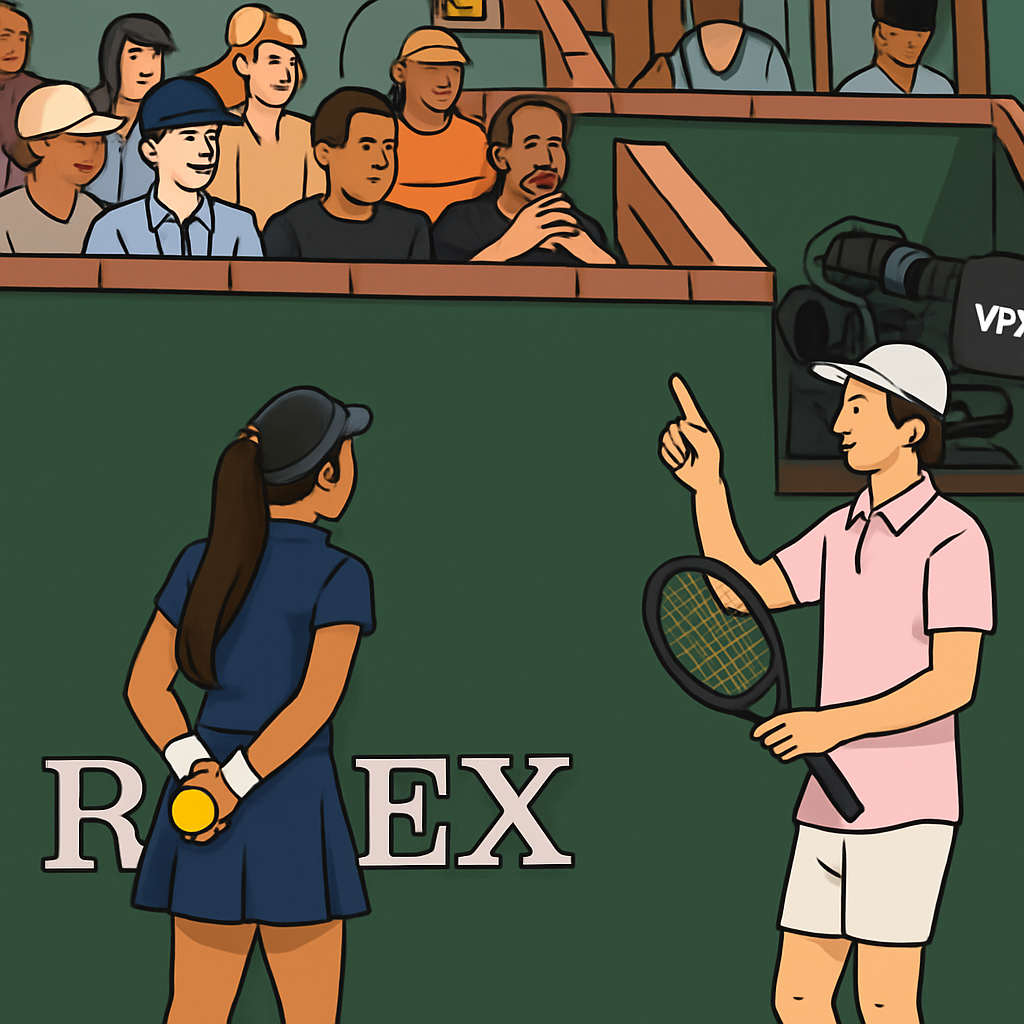
ROME — The normally genteel atmosphere of the Foro Italico was shattered on Monday by a startling confrontation that has become the talk of the tennis world. In a dramatic second-round match at the Italian Open, world No. 2 Jannik Sinner was forced to halt play and directly address a disruptive spectator, an incident that unfolded just hours after Novak Djokovic was subjected to persistent booing from the same crowd—a reaction that ultimately led to a fan being ejected from the stadium.
A Tense Moment on Center Court
The incident occurred during Sinner’s match against Russian player Roman Safiullin. As Sinner prepared to serve at a critical juncture, a loud, extended noise—akin to a horn or a shout—emanated from the stands, breaking his concentration. The Italian star, known for his calm demeanor, immediately turned to the chair umpire, Mohamed Lahyani, and pointed decisively towards a section of the crowd. After a brief discussion, Lahyani addressed the spectator over the stadium microphone, issuing a firm warning: "Ladies and gentlemen, please respect the players. One more time and you will be removed."
However, the situation did not end there. Visibly frustrated, Sinner took matters into his own hands. He walked towards the baseline, directly facing the section where the disturbance originated, and engaged in a brief but pointed verbal exchange with the fan. The crowd, largely supportive of their home favorite, fell into a hushed silence before erupting in applause for Sinner’s stance. The 22-year-old later explained his actions, stating, "I heard someone making a noise during my serving motion. It’s not the first time. I got pissed off, to be honest."
Djokovic Faces the "Boo Brigade"
Earlier in the day, the center court crowd had already shown its combative side during Novak Djokovic’s straight-sets victory over France’s Corentin Moutet. Throughout the match, a small but vocal group of fans relentlessly jeered the 24-time Grand Slam champion, booing his winners and errors alike. The animosity peaked after Djokovic sealed his win. As is his custom, the Serb acknowledged all four sides of the court with a gesture of gratitude. When his wave to one particular section was met with a chorus of boos, Djokovic responded by putting his hand to his ear, as if to say, "I can’t hear you," further inciting the crowd.
The tournament organizers, however, had heard enough. Using security and audio detection technology to pinpoint the source, officials identified and subsequently ejected one of the primary instigators from the Foro Italico. Tournament director Sergio Palmieri confirmed the action, emphasizing a zero-tolerance policy for behavior that crosses the line from passionate support into harassment. Djokovic, a six-time champion in Rome, addressed the incident in his post-match press conference with a mix of weariness and defiance.
"I’ve been experiencing that for over 20 years, so I know how to handle it by now," he said. "At the end of the day, I focus on what I need to do. But a few guys, they went over the line the entire match. That’s why at the end, I just had to respond. You can’t touch a player, but you can’t also be allowed to throw insults or yell during a point to try and distract the player. That’s not fair."
A Growing Pattern of Fan Misconduct
The events in Rome are not isolated but part of a concerning trend across professional tennis in 2024. The sport has witnessed an increase in high-profile incidents where fan behavior has directly impacted matches, moving beyond traditional partisanship into disruptive and sometimes abusive territory. This shift challenges the long-held etiquette of tennis, where silence during points is sacrosanct.
Key incidents this year that set the stage for Rome include:
- At the Australian Open, a spectator was removed after repeatedly yelling during points in a match between Alexander Zverev and Cameron Norrie.
- In Indian Wells, a fan’s loud outburst during a crucial point prompted Coco Gauff to plead with the chair umpire, "Can you please tell them to be quiet?"
- At the Madrid Open, a similar pattern of targeted noise during serves led to multiple player complaints and official warnings.
This pattern suggests a new, more confrontational dynamic is emerging. Players and analysts point to several potential factors, including the influence of other high-energy sports, the consumption of highlights and short-form content that glorifies confrontation, and a post-pandemic shift in crowd behavior. The core issue, as highlighted by both Sinner and Djokovic’s reactions, is the intentional disruption of play at the most delicate moments.
The Fine Line: Passion vs. Punishment
The incidents raise complex questions about the role of fans in modern tennis. The sport thrives on passionate, vocal support, especially in team competitions like the Davis Cup or in national tournaments like the Italian Open. The line, however, is drawn at actions intended to unfairly disadvantage a player. The ATP and WTA rules grant chair umpires broad authority to penalize disruptive spectators, with a graduated response system:
- Verbal warning announced to the specific section or individual.
- Removal of the offending spectator(s) from the stadium.
- Potential forfeiture of the match for the player benefiting from the disruption, though this is an extreme last resort.
In Rome, the enforcement was swift. The ejection following Djokovic’s match and the official warning during Sinner’s sent a clear message that the tournament would uphold these standards. This proactive stance was praised by many within the sport. Veteran coach and commentator Darren Cahill noted, "The players deserve a fair contest. Noise between points is fantastic, but deliberate interference during the serve or a rally is cheating, plain and simple."
Player Reactions and the Road Ahead
Sinner, who went on to win his match against Safiullin 6-3, 6-4, expanded on his court-side confrontation in his press conference. He expressed understanding for fan enthusiasm but stressed a critical distinction. "I love the crowd, I love the fans," he stated. "But when somebody is trying to bother you on purpose in the serving motion, this is not correct. I think the referees or whoever should do a little bit more, because this is not the way."
His comments underscore a growing sentiment among the playing corps: they want tournaments to be more preemptive and consistent in enforcing conduct rules. The burden, they argue, should not fall on the players to police the crowd in the heat of competition. The physical and mental toll is significant, as focusing on a 130-mph serve while filtering out targeted noise is an immense challenge.
As the tour moves to Roland-Garros and the grass-court season, all eyes will be on how other tournaments handle similar situations. The Roman response—a combination of technology-aided identification, swift ejection, and public support for the players—may become a new template. The ultimate goal is to preserve the electric atmosphere that makes tennis unique while protecting the integrity of the sport itself.
The confrontation initiated by Jannik Sinner and the jeering endured by Novak Djokovic in Rome are more than just dramatic headlines. They are a stark reflection of a sport at a crossroads, grappling with how to evolve its spectator culture. The passionate Italian crowd, often described as the most knowledgeable and fervent in tennis, ironically provided the stage for this pivotal moment. The message from the Foro Italico is now echoing across the tennis world: the players are listening, and they are no longer willing to stay silent.