
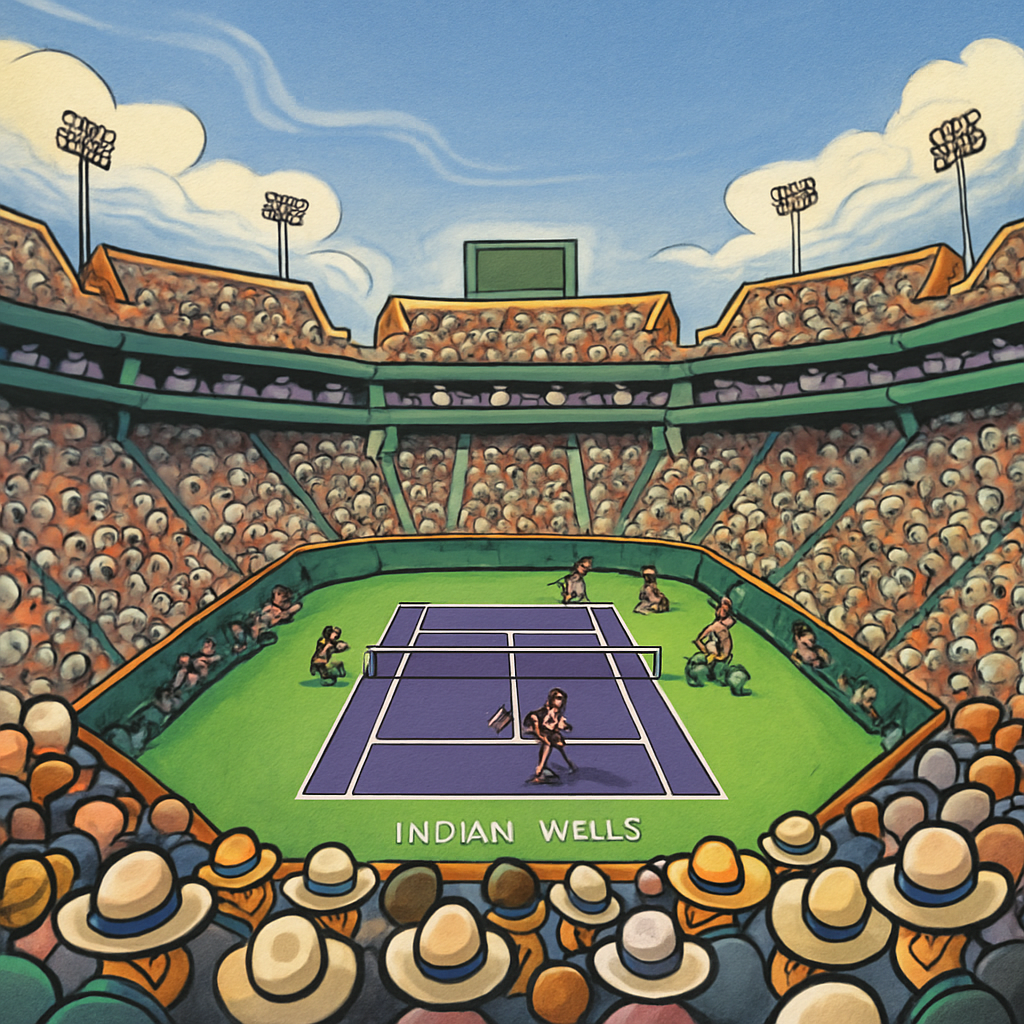
INDIAN WELLS — The serene desert setting of the BNP Paribas Open was jolted by an unexpected and alarming interruption on Tuesday, casting a shadow over the tournament's famed courts. A medical emergency in the stands during a match between Alexander Zverev and Alexander Bublik brought play to a dramatic halt, underscoring the fragility of the sporting spectacle. Meanwhile, in a quieter but equally significant moment, Britain's Emma Raducanu received a stark warning about the relentless demands of the professional tour from a seasoned champion, adding a layer of introspection to the day's events.
A Chilling Halt: The Stadium Emergency
The incident occurred during the second set of the highly anticipated men's singles match on Stadium 1. With fourth seed Alexander Zverev leading 6-4, 4-5 and Alexander Bublik serving to level the match, a spectator in the lower bowl suffered a serious medical episode. A concerned voice from the crowd alerted chair umpire Mohamed Lahyani, who immediately suspended play. Zverev, demonstrating swift presence of mind, rushed to the umpire's chair, grabbed the tournament doctor's medical kit, and threw it into the stands to aid the initial response.
The atmosphere shifted from competitive tension to collective concern as tournament medical staff and paramedics sprinted to the scene. For over ten minutes, players, officials, and the capacity crowd waited in a hushed silence. The gravity of the situation was palpable. Zverev and Bublik sat on their benches, draped in towels, their focus entirely diverted from the match. The spectator was eventually stretchered out of the stadium to receive further medical attention. Tournament officials later confirmed the individual was "transported to a local hospital for further evaluation and is in stable condition."
Upon the resumption of play, both players struggled to reclaim their rhythm, a common challenge after such a lengthy and distressing delay. Zverev would eventually close out the match 7-5 in the second-set tiebreak. In his post-match press conference, the German reflected on the surreal moment, stating, "You see a person lying down, and it's clearly not good. I think both of us were in shock. You play a match and you're focused on that, and then suddenly you're reminded that life is so much more important."
Raducanu's Reality Check: A Champion's Warning
While the emergency unfolded on Stadium 1, a narrative of a different kind was developing regarding former US Open champion Emma Raducanu. The British star, who has been navigating a comeback from multiple surgeries, secured a solid first-round victory over Rebeka Masarova. However, her path forward was framed by candid comments from three-time major champion and former world No. 1 Andy Roddick. Speaking on his podcast, Roddick offered a blunt assessment of the challenges facing Raducanu as she seeks to return to the sport's summit.
Roddick emphasized that Raducanu’s stunning 2021 US Open triumph, achieved as a qualifier without dropping a set, created an almost impossible standard to maintain. He warned that the tour offers no respite, especially for a player with a target on her back. "The tour doesn't care about your circumstances. It doesn't care if you're coming back from injury, it doesn't care if you won a major as a teenager," Roddick stated. "Every single person you play is capable. Every single person is a professional. Every single person is trying to take your head off."
This warning highlights the unique pressure on Raducanu, whose career has been a whirlwind of spectacular highs and injury-induced lows. Roddick’s core message was about managing expectations, both external and internal. He pointed out that the relentless weekly grind of the tour—the travel, the different conditions, the constant pressure—is a separate challenge from winning a one-off, two-week slam. For Raducanu to succeed long-term, she must build a consistent foundation. Key areas of focus include:
- Physical Resilience: Building a body capable of withstanding the 10-month season.
- Tactical Maturity: Developing a plan B and C for days when her best shots are off.
- Mental Fortitude: Accepting losses as part of the process, not as a crisis.
Raducanu herself has recently spoken about adopting a more patient, long-term view. After her first-round win, she noted, "I'm just taking it day by day. I'm feeling positive about where I'm at and my level, and just looking forward to the next one." This mindset will be crucial as she faces a stern second-round test against 30th seed Dayana Yastremska.
The Unpredictable Theatre of Indian Wells
The dual events of the day—the court-side emergency and the sobering analysis of a young star's journey—perfectly encapsulated the unpredictable drama of a tournament like Indian Wells. It is a place where world-class athleticism is performed against a backdrop of very human realities. The incident during the Zverev-Bublik match served as a stark, universal reminder of the vulnerability that exists just beyond the painted lines. In an instant, the pursuit of ranking points and prize money was rendered trivial, uniting everyone present in a shared hope for a stranger's well-being.
Conversely, the discourse around Raducanu represents the internal, enduring battles that define a career. Indian Wells, with its slow, gritty courts and demanding conditions, is often called a "mini-major." It is a tournament that tests not just shot-making but patience, physical conditioning, and mental stamina over nearly two weeks. Roddick’s comments, while blunt, underscore the tournament's role as a proving ground. Success here requires the very consistency and resilience he prescribes.
Looking Ahead: Resilience on Display
As the tournament progresses, the themes of the day are likely to resonate. Players will continue to navigate the fine line between intense professional focus and human empathy. For Alexander Zverev, advancing in the draw after such a disruption is a testament to a veteran's composure. For Emma Raducanu, each match is a step in the arduous process of answering the questions posed by pundits and rebuilding a career on her own terms. The Indian Wells garden setting is beautiful, but the competition within it remains one of the most grueling and revealing on the tennis calendar.
In conclusion, Tuesday at Indian Wells was a powerful juxtaposition of sport's fleeting nature and its enduring challenges. The swift action of players and staff during a crisis highlighted the community within the sport, while the frank discussion about a champion's path reminded us that professional tennis is a marathon of relentless pressure. As the desert sun sets on another day, the tournament moves forward, carrying with it the memory of a moment that put everything in perspective and the ongoing stories of athletes striving for greatness amidst immense expectation.