
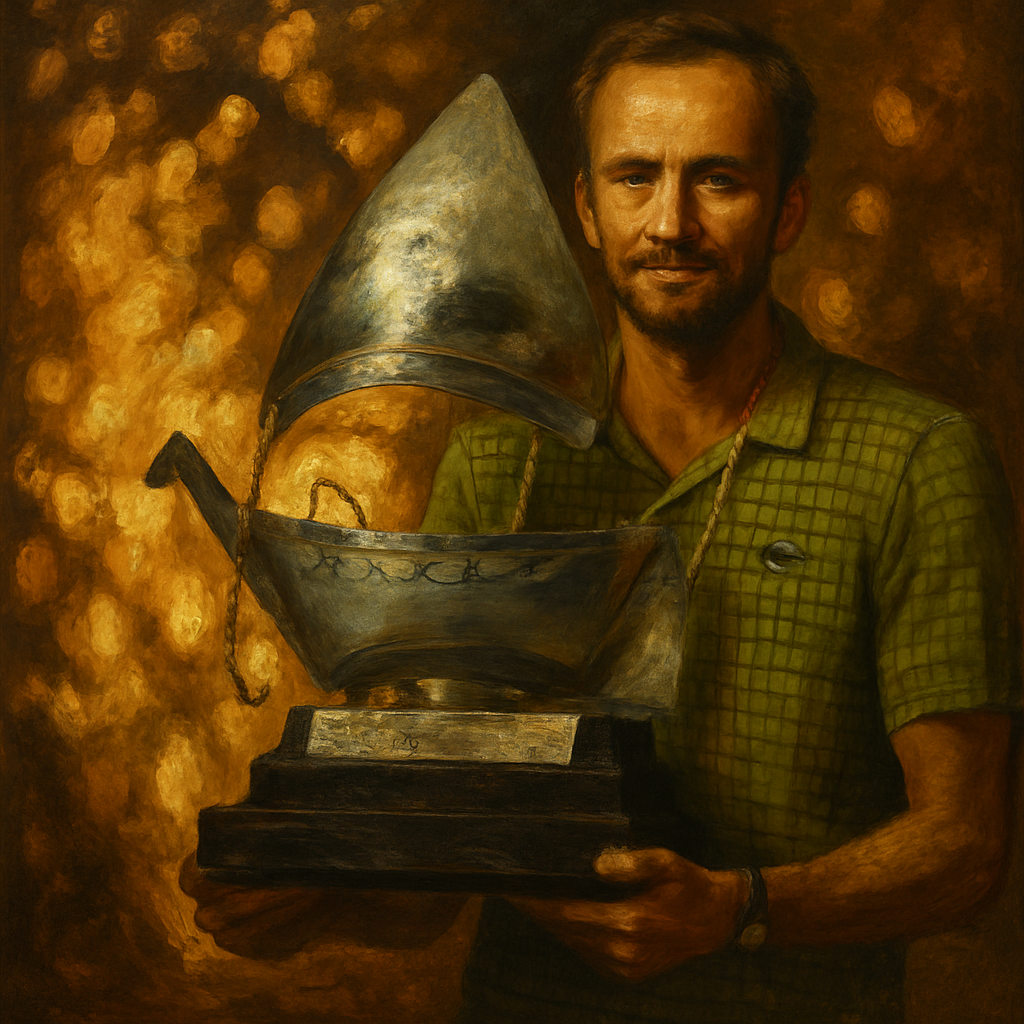
DUBAI — In a surreal twist of fate, newly crowned Dubai Duty Free Tennis Championships winner Daniil Medvedev finds himself stranded in the glittering emirate, his travel plans thrown into chaos not by a sporting injury, but by geopolitical turmoil. The world No. 4, who clinched a hard-fought victory over Frenchman Ugo Humbert on Saturday, has been unable to depart Dubai following Iran’s unprecedented missile and drone strikes on Israel over the weekend.
A Champion in Limbo
Medvedev’s triumph at the Aviation Club, his first title of the 2024 season, was supposed to be a celebratory springboard to his next tournament. Instead, the Russian star has been caught in the widespread aviation disruption that rippled across the Middle East. In a video update posted to his social media channels from what appears to be his Dubai hotel, a relaxed yet bemused Medvedev addressed his unexpected predicament. "I'm still in Dubai," he confirmed with a wry smile.
The cause of the disruption stems from Iran’s direct attack on Israeli territory on April 13th, which involved over 300 projectiles. In response, several countries, including Israel, Jordan, Iraq, and Lebanon, temporarily closed their airspace as a security precaution. While most airspaces have since reopened, the cascading effect caused massive flight cancellations and reroutings worldwide, with Dubai International Airport—one of the world’s busiest aviation hubs—experiencing significant knock-on delays and crew scheduling issues.
Navigating the Fallout
For an athlete on the tightly scheduled ATP Tour, such disruptions are more than a mere inconvenience. Medvedev is slated to compete next at the ATP Masters 1000 event in Monte Carlo, which begins on April 7th. The disruption risks cutting into his crucial preparation time for the European clay-court season, a surface he has historically found challenging. In his video, Medvedev outlined the logistical nightmare, stating his original flight was canceled and his team was scrambling for solutions. "We are trying to find a flight. It's not easy," he admitted.
The situation highlights the fragile intersection between global sports and world events. Tennis professionals, despite their elite status, are not immune to the practical realities of international travel during periods of heightened tension. Medvedev’s experience mirrors that of countless other travelers in the region, though his platform brings unique attention to the issue.
The Ripple Effect on Travel
The immediate aftermath of the airspace closures created a domino effect. Key impacts included:
• Hundreds of canceled flights across multiple airlines serving the Middle East.
• Severe delays for flights that were already in the air, forcing diversions and extended holding patterns.
• Crew displacement and scheduling conflicts, as airline staff were stuck out of position.
• A backlog of stranded passengers competing for limited seats on subsequent flights.
This logistical gridlock is what ultimately trapped Medvedev in Dubai. While private aviation offers more flexibility, even those corridors were subject to restrictions and required careful diplomatic and security coordination during the peak of the crisis.
Making the Best of It
Characteristically pragmatic, Medvedev has taken the situation in stride. His video update was less a complaint and more a matter-of-fact report to his fans. He has used the unplanned extra time in Dubai to recover from the physical toll of a tournament week and, presumably, to continue his physical training where possible. "We'll see when we can fly out," he said, embodying the patience now required.
The tennis community has watched with sympathy, noting the stark contrast between the high of a title victory and the frustrating low of travel paralysis. Fellow players and commentators have expressed hope for a swift resolution, understanding that consistent practice and acclimatization are key components of success at the highest level. The Monte Carlo tournament, played at the picturesque Monte-Carlo Country Club, demands specific adjustments for its slow, red clay, making every day of preparation valuable.
A Broader Perspective
Medvedev’s stranded status serves as a microcosm of a world where sports cannot be fully insulated from conflict. The ATP Tour, a truly global circuit, is perpetually vulnerable to such disruptions, whether from pandemics, natural disasters, or political instability. The incident is a reminder of the complex behind-the-scenes logistics that underpin the seamless spectacle of professional tennis. Travel teams and tournament organizers constantly monitor global events, but some situations, like sudden airspace closures, offer little warning.
Furthermore, Medvedev’s nationality adds an unspoken layer of complexity. As a Russian competing under a neutral flag due to the ongoing war in Ukraine, his travel logistics in a tense geopolitical climate are inherently more scrutinized and potentially more complicated, though there is no indication this specific incident is related to his nationality. The primary cause remains the broad, regional aviation shutdown.
Looking Ahead
As of the latest updates, commercial air travel through the Middle East has largely normalized, though the backlog of passengers will take days to clear. Medvedev and his team are likely exploring all avenues, including potential connections through alternative hubs or adjusted travel dates. The expectation is that he will arrive in Monaco with just enough time to prepare, turning a story of disruption into a test of adaptability.
His experience underscores a modern reality for the touring athlete: victory on the court can be swiftly followed by unpredictable challenges off it. Daniil Medvedev, the Dubai champion, remains for now a champion in waiting—waiting for a flight, waiting to resume his campaign, and waiting for the world beyond the baseline to settle just enough to let him move on to his next match.