
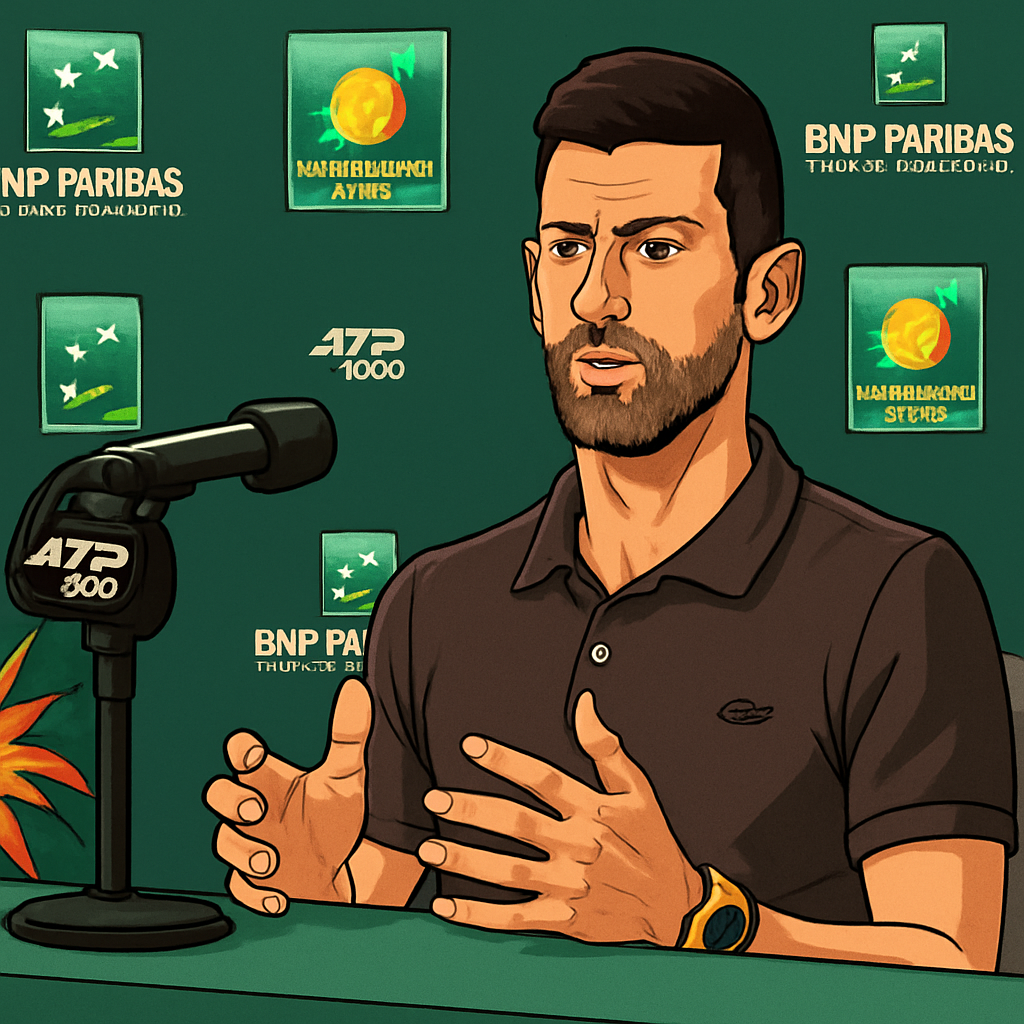
INDIAN WELLS — Novak Djokovic’s return to the BNP Paribas Open after a five-year absence was shockingly brief, ending in a third-round defeat to unheralded Italian Luca Nardi. Yet, in the wake of that stunning loss, the 36-year-old Serbian champion delivered a message that resonated far louder than the result itself: his competitive fire burns as fiercely as ever, with his sights now set on a horizon stretching all the way to the 2028 Los Angeles Olympics.
Speaking candidly to reporters after the 6-4, 3-6, 6-3 loss to the world No. 123, Djokovic dismissed any notion that the early exit signaled a waning of his legendary drive. Instead, he framed it as a temporary setback, a "wake-up call" in a season where he has yet to claim a title. More significantly, he articulated a long-term ambition that few athletes at his stage dare to voice. "I am trying to make the most of my career, use this year and the next as much as I can," Djokovic stated, before dropping the bombshell. "Hopefully the Olympics, that’s definitely a big goal for me, Paris and then maybe even Los Angeles."
A Scare, But Not a Signal
The loss to Nardi was undeniably a surprise. Djokovic, the world No. 1 and holder of a record 24 Grand Slam titles, appeared uncharacteristically out of sync, struggling with his timing and committing 35 unforced errors. For critics and fans alike, it was a moment that invited speculation. Was this the beginning of a natural, inevitable decline for a player who has dominated the sport for over a decade? Djokovic’s response was unequivocal. He refused to attribute the performance to age or motivation, instead pointing to a general lack of top-level matches in 2024.
"No, no, it’s not concerning," he asserted regarding his form. "It’s really just taking it as it is and trying to move on. I didn’t have a great tournament, that’s it. I’ve had many throughout my career, it’s not the first one." He emphasized that his desire to compete at the highest level remains intact, fueled by a meticulous approach to his body and schedule. This perspective transforms the Indian Wells result from a crisis into a data point—a valuable, if unpleasant, piece of feedback as he builds towards the peaks of the season.
The Allure of Olympic Gold
Djokovic’s explicit mention of the 2028 Los Angeles Games is what truly recontextualizes his current journey. At 36, targeting an event four and a half years away, when he will be 41, is a staggering declaration of intent. It underscores that his career is no longer measured merely in seasons, but in Olympic cycles. The pursuit of an Olympic gold medal in singles is one of the few accolades that has eluded him, a missing piece in an otherwise complete trophy cabinet.
His Olympic history is a tale of heartbreak and near-misses:
- 2008 Beijing: Won a bronze medal in singles.
- 2012 London: Finished fourth, losing the bronze-medal match to Juan Martín del Potro.
- 2016 Rio: Suffered a shocking first-round exit.
- 2020 Tokyo (held in 2021): Lost the bronze-medal match to Pablo Carreño Busta, then withdrew from the mixed bronze match due to injury, stating he was "mentally and physically depleted."
The Paris 2024 Games, with tennis being held on the iconic clay of Roland Garros—a venue where he has won three French Open titles—present a golden opportunity. But by already looking beyond Paris to Los Angeles, Djokovic is sending a clear message: his story is far from over, and he is willing to structure the final chapters of his career around this quest.
The Blueprint for Longevity
How does an athlete plan to compete at the highest level into his forties? For Djokovic, it is a holistic science. His longevity is built on several pillars that allow him to even contemplate a 2028 campaign:
- Peak Physical Conditioning: His legendary flexibility, diet, and recovery protocols are tailored for sustained performance.
- Strategic Scheduling: He has become increasingly selective with his tournament calendar, prioritizing Grand Slams and major events to preserve his body.
- Mental Fortitude: His ability to detach from setbacks, like Indian Wells, and maintain a long-term vision is perhaps his greatest strength.
- Evolution of the Game: Advances in sports science, nutrition, and equipment are enabling athletes to extend their prime years longer than ever before.
Djokovic himself acknowledged this calculated approach. "I’m not playing as many tournaments as I did five or ten years ago, and I want to peak at the biggest events," he explained. This means occasional early losses at other tournaments are not just possible, but accepted, as part of a grander plan to be at his best for the moments that matter most.
The Precedent of Champions
While ambitious, Djokovic’s goal is not without precedent in tennis. Roger Federer competed at the 2021 Olympics at age 39, though injuries ultimately curtailed his final years. In other sports, Tom Brady famously played in the NFL until 45. Djokovic’s specific reference to LA 2028 suggests he is studying these models of endurance. He is not simply hoping to hang on; he is planning to contend, to add the ultimate Olympic chapter to a legacy that already seems untouchable.
Looking Ahead: The Road to Paris
The immediate focus now shifts to the clay-court season and the build-up to Roland Garros and the Paris Olympics. The Indian Wells "scare" will likely intensify Djokovic’s preparation. Expect him to fine-tune his game, potentially adding a tournament to his schedule to find the competitive rhythm he felt was lacking in the California desert. Every practice session, every match, will now be viewed through the dual lens of the upcoming French Open and the Olympic tournament just weeks later.
His rivals, from the young challengers like Carlos Alcaraz and Jannik Sinner to seasoned contenders like Rafael Nadal (who plans to return for the Olympics), now have a renewed understanding of Djokovic’s timeline. He isn’t just playing for this year’s titles; he is on a multi-year mission. This long-view mindset could make him even more dangerous in the short term, as individual losses lose their power to derail his confidence.
Conclusion: A Champion’s Horizon
Novak Djokovic’s statement after Indian Wells was far more than a post-match press conference. It was a fresh retirement statement of a different kind—a statement of non-retirement. By openly targeting the 2028 Olympics, he has redefined the narrative around his career’s final act. No longer is the question "When will he retire?" but rather "What more can he achieve on this self-extended journey?"
The early exit at Indian Wells, therefore, becomes a minor plot point in a much larger story. It is a story of unprecedented longevity, of chasing the last remaining prize, and of a champion whose ambition continues to outpace time itself. As Djokovic himself put it, looking towards the future, "I still feel like I have years in my legs and in my heart." For the tennis world, that means the era of Novak Djokovic, fueled by the dream of Olympic gold, is poised to continue for years to come.