
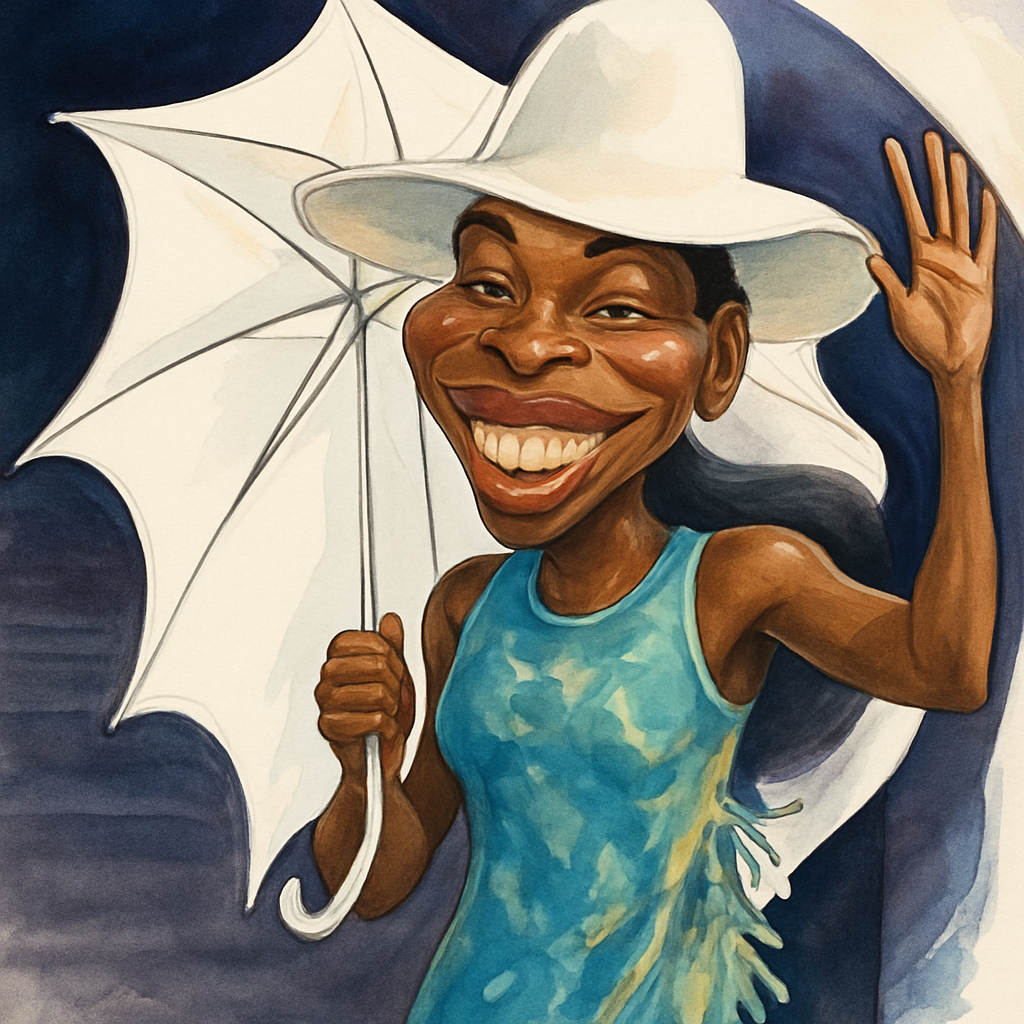
MELBOURNE — The Australian Open’s opening day is always a spectacle of color and competition, but on Monday, all eyes were drawn to a creature of the deep sea gliding across the blue hardcourt of Rod Laver Arena. Naomi Osaka, in her long-awaited Grand Slam return, didn’t just secure a hard-fought 6-3, 7-6(9) victory over Croatia’s Antonia Ruzic; she made a profound sartorial statement that became the talk of the tournament.
The four-time major champion, playing her first Slam since becoming a mother, stepped onto the court in a custom Nike outfit that was impossible to ignore. A vibrant, swirling gradient of pink, purple, and blue adorned her dress, while a translucent, pleated overskirt billowed with her every explosive movement. The internet immediately lit up with comparisons, but it was Osaka herself who confirmed the inspiration. “It’s modelled on a jellyfish,” she revealed in her post-match press conference, a smile playing on her lips.
More Than Just Aesthetic: The Jellyfish as Muse
The choice was far from arbitrary. In explaining her team’s creative process, Osaka painted a picture of deliberate symbolism. “We were thinking about something that was really beautiful but also had a dangerous side to it,” she said. The jellyfish, a creature of mesmerizing beauty and potent sting, perfectly encapsulated the duality Osaka sought to project in her comeback: grace and power, fluidity and ferocity.
The design team at Nike took the concept and ran with it. The colors mimic the bioluminescent glow of certain deep-sea jellyfish, while the ethereal overskirt captures their hypnotic, pulsing motion through water. Commentators and fans were united in their praise. Rennae Stubbs, the former player and analyst, called it “one of the most spectacular tennis outfits I’ve ever seen.”
The outfit’s impact was multifaceted. It served as a powerful declaration of Osaka’s renewed identity—both as an athlete and a fashion icon. It also provided a fascinating psychological lens through which to view her performance. Throughout the match, the flowing skirt seemed to accentuate her movement, creating a visual poetry that contrasted sharply with the brutal power of her groundstrokes.
A Battle-Tested Return: Substance Behind the Style
While the outfit stole headlines, the match itself was a gritty testament to Osaka’s fighting spirit. Facing the 19-year-old qualifier Antonia Ruzic, Osaka showcased the game that made her a champion: colossal serves that topped 190 km/h and punishing forehands that painted the lines. She raced to a 5-1 lead in the first set, looking every bit the former world No. 1.
However, the second set revealed the inevitable rust from her 15-month maternity leave. Unforced errors crept in, and the fearless Ruzic began to find her range, pushing Osaka to the brink. The tension peaked in a dramatic tiebreak where Osaka squandered three match points and saved two set points against her. The key moments highlighted her current state:
- The Serve as Savior: On her fourth match point at 10-9 in the tiebreak, Osaka unleashed an unreturnable 181 km/h serve out wide, a clutch delivery under immense pressure.
- Emotional Resilience: Visibly frustrated at times, she repeatedly reset, took deep breaths, and engaged in positive self-talk, a skill honed through her well-documented mental health advocacy.
- Patience in the Process: “I was really nervous the entire time,” she admitted afterward, acknowledging the journey ahead.
The 96-minute battle was, in many ways, the perfect first test. It provided a victory, exposed areas for improvement, and proved her competitive fire burns as brightly as ever. “I think I played pretty well given the circumstances,” was her characteristically understated assessment.
The Narrative of Naomi 2.0: Motherhood & Mission
This Australian Open is about more than results for Osaka; it’s the first major chapter of her life as a mother-athlete. She has spoken openly about how motherhood has reshaped her perspective, giving her a newfound sense of purpose and calm. The jellyfish outfit, in its otherworldly beauty, felt like a visual representation of this new phase—something evolved, unique, and powerful.
Her daughter, Shai, was a constant presence in her thoughts. “I was overthinking about, like, when she’s older, she’s going to see this match, and I want her to think that I’m cool,” Osaka joked, revealing the personal motivation that now fuels her. This blend of personal joy and professional ambition defines her comeback narrative.
The tennis world has eagerly awaited the return of one of its most charismatic and impactful stars. Her absence left a void not just in the winner’s circles of Slams, but in the sport’s cultural conversation. With this win, and the stunning fashion statement that accompanied it, Osaka signaled she is ready to reclaim her place on both fronts.
A Statement Made, A Journey Begun
Naomi Osaka’s first-round victory was a multi-layered success. On the scoreboard, it was a straight-sets win. In the broader story of her career, it was a resonant announcement of her return, packaged in a metaphor of aquatic elegance and danger. The jellyfish outfit will be remembered as one of the iconic looks of this Australian Open, a perfect fusion of art and athletic intent.
As she prepares for her second-round clash against the formidable Caroline Garcia, the questions will shift from “Can she return?” to “How far can she go?”. If Monday was any indication, Osaka is navigating this new chapter with a clear vision: to blend the serene strength of her personal life with the fierce competitiveness that made her a champion. She proved that her game, much like her inspired attire, remains a breathtaking force of nature.