
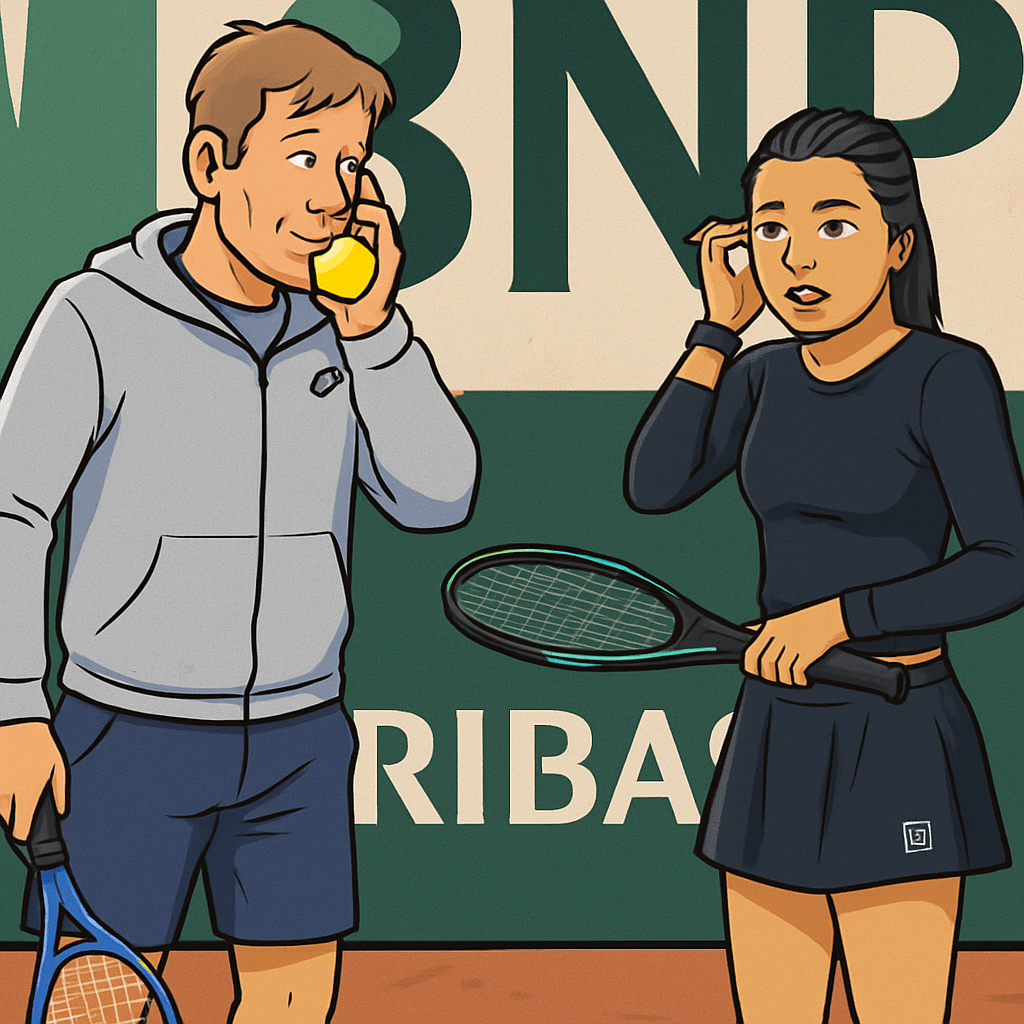
LONDON — In the high-stakes, often transient world of professional tennis coaching, few partnerships carry the emotional and narrative weight of the reunion between Emma Raducanu and Mark Petchey. As the British star prepares for her grass-court campaign, a simple, four-word comment from Petchey has cut through the noise, offering a tantalising glimpse into their renewed collaboration and the clear, focused plan they seem to be forging.
The comment came not in a grand press conference, but in a more intimate setting. Following a practice session at the LTA’s National Tennis Centre, Petchey was asked about their work. His response was succinct yet profoundly telling: “We’re just building foundations.” For a player whose career has been a whirlwind of historic triumph, injury setbacks, and relentless public scrutiny, these four words speak volumes about the philosophy now guiding her path.
A Return to Roots: Rekindling a Proven Partnership
Petchey, a respected analyst and former coach, is no stranger to Raducanu’s game. He was the first WTA coach to work with her professionally, guiding her through her memorable Wimbledon debut in 2021, where she reached the fourth round as a wildcard ranked outside the world’s top 300. That breakthrough set the stage for her fairytale US Open victory just two months later. Their split was amicable, driven by Raducanu’s meteoric rise and the subsequent search for tour-hardened experience.
Since that US Open win, Raducanu’s journey has been challenging. A revolving door of coaches, coupled with persistent wrist and ankle injuries requiring surgeries, saw her ranking plummet and her time on court limited. Her return in 2024 has been a patient process of rebuilding match fitness and confidence. Reuniting with Petchey, therefore, feels less like a new experiment and more like a return to a trusted source—a coach who knew the prodigious talent before the global fame and its attendant pressures.
Decoding "Building Foundations": A Multi-Layered Approach
Petchey’s phrase, “building foundations,” is a deliberate departure from talk of immediate results or grand slam expectations. It signals a shift in focus to the core, often unglamorous, elements that sustain a long career. In the context of Raducanu’s recent history, this foundational work appears to be built on several key pillars:
- Physical Resilience: After multiple surgeries, ensuring Raducanu’s body can withstand the rigours of the tour is paramount. This means tailored strength and conditioning, not just to compete, but to train consistently week-in, week-out.
- Technical Reinforcement: Quietly refining technique, particularly on the vulnerable backhand wing affected by wrist issues, to create a reliable and robust game less prone to breakdown.
- Tactical Clarity: Re-establishing a clear game identity. Petchey’s analysis has often highlighted Raducanu’s exceptional hand speed and ability to take the ball early; the foundation likely involves constructing points to maximise these innate strengths.
- Psychological Stability: Creating a calm, consistent training environment to rebuild confidence away from the spotlight, fostering the mindset that allowed her to play with such fearless freedom in 2021.
The Grass-Court Laboratory: Wimbledon as a Litmus Test
The timing of this reunion is strategically significant. The grass-court season, culminating at Wimbledon, provides the perfect laboratory for this foundational work. Grass is Raducanu’s most successful surface, the scene of her initial breakthrough. It rewards the aggressive, first-strike tennis that is her natural forte. Petchey’s plan seems to be to leverage this familiarity and affinity. As he has noted in commentary, “On grass, her game simplifies beautifully. It’s about first serves, first returns, and trusting her instincts.”
Success this summer may not be measured solely in titles or deep runs, though those would be a welcome bonus. Instead, the metrics will be consistency of performance, durability through matches and tournaments, and the visible solidity of her game under pressure. Each match on grass is an opportunity to layer another brick onto the foundation Petchey is meticulously constructing.
A Contrast in Coaching Philosophies: Patience Over Panic
Petchey’s approach stands in stark contrast to the high-turnover strategy that defined much of Raducanu’s post-US Open period. Where previous arrangements sometimes seemed geared towards an immediate technical overhaul or navigating a specific tournament, Petchey’s “foundations” mantra suggests a commitment to long-term development. It is a philosophy built on patience and trust, acknowledging that Raducanu’s unique path—skipping the traditional apprenticeship in the lower tiers of the tour—requires a bespoke and nurturing rebuild.
This sentiment was echoed by former British No. 1 Annabel Croft, who observed, “What Emma needs more than anything is continuity and someone who believes in her unconditionally. Mark does. He’s not there for a quick fix; he’s there to help her build a career, not just a comeback.” This long-view perspective is arguably the most crucial component of the foundation, providing the stability Raducanu has arguably lacked.
The Road Ahead: A Sustainable Ascent
The ultimate goal of this foundational phase is clear: to engineer a sustainable ascent back up the rankings. The aim is to construct a game and a physical condition that allows Raducanu to compete regularly on the WTA Tour, accumulating points and confidence without the constant fear of injury or regression. Petchey’s experience as both a coach and an analyst gives him a unique toolkit for this task—he understands the technical nuances, the physical demands, and the media narrative, allowing him to shield his player where necessary.
As the tennis world watches Raducanu’s every move on the grass, the most telling signs of progress may be subtle: a more potent first-serve percentage, increased comfort in extended rallies, and a demeanour that reflects enjoyment rather than burden. These are the hallmarks of a solid foundation. In forgoing complex jargon for the simple, powerful imagery of construction, Mark Petchey has not only outlined his plan for Emma Raducanu but has also recalibrated expectations, advocating for patience as the greatest investment in her extraordinary talent.
Their reunion, therefore, is more than a coaching change; it is a strategic recalibration. By choosing to “build foundations” with a trusted ally, Raducanu is signalling a commitment to the long game. In an era of instant gratification, this old-school approach—prioritising substance over spectacle, durability over dazzle—may well be the key to unlocking the second, and potentially most rewarding, chapter of her captivating career.