
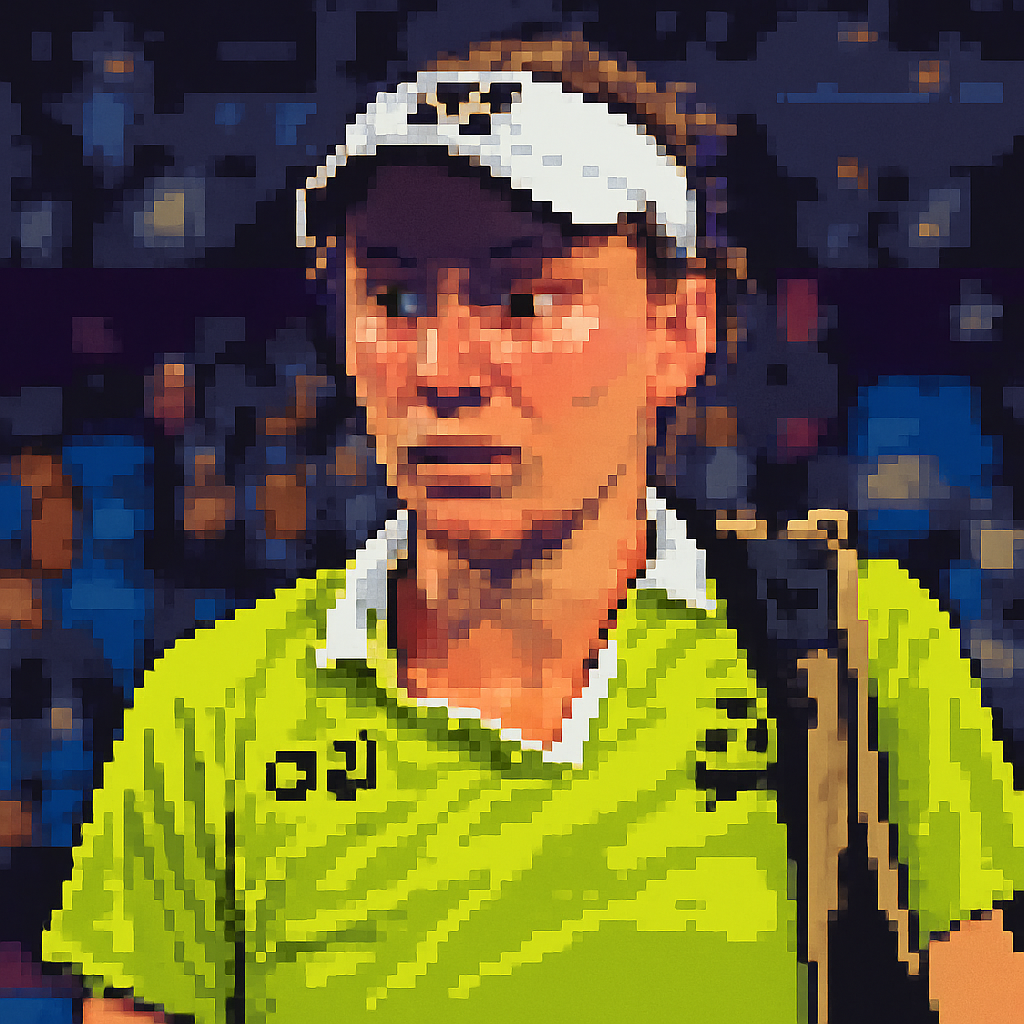
ABU DHABI — The first tournament after a Grand Slam triumph is often a tricky proposition, a moment where the physical and emotional hangover from a major victory can manifest. For Elena Rybakina, the newly crowned Australian Open champion, that reality arrived at the Mubadala Abu Dhabi Open, where she suffered a surprising 6-4, 4-6, 6-1 defeat to unseeded Brazilian Beatriz Haddad Maia in the quarterfinals. Yet, far from a cause for alarm, the loss served as a powerful statement of intent to her rivals for the rest of the season.
Rybakina’s defeat marked her first loss since lifting the Daphne Akhurst Memorial Cup in Melbourne, ending a seven-match winning streak that began at the start of the year. The match itself was a rollercoaster, with the Kazakhstani star struggling to find her dominant rhythm against the relentless left-handed aggression of Haddad Maia. After splitting the first two sets, Rybakina’s energy appeared to dip dramatically in the decider, a factor she was quick to acknowledge in her characteristically blunt post-match assessment.
Acknowledging the Physical Toll
In her press conference, Rybakina did not shy away from the obvious. The whirlwind of victory, travel, and immediate re-engagement with the tour had taken its toll. "It was a tough match. I didn't start that well. I was not moving that great," she stated. She pointed directly to the physical demands of the last month, saying, "It's been a lot of matches at the beginning of the year, so I felt a bit tired physically."
This admission of fatigue is significant, not as an excuse, but as a declaration of her current ceiling. It signals that even at less than 100%, she pushed a top-20 caliber opponent to three sets. The fact that her "B-game" remains so competitive is a daunting prospect for the rest of the WTA field. Her focus immediately shifted to recovery and the road ahead, emphasizing a professional approach to managing her schedule and fitness.
The Bigger Picture: A Season of Ambition
The Abu Dhabi result, while a stumble, does little to dim the bright outlook for Rybakina’s 2024 campaign. If anything, it reinforces her status as a premier force. Her start to the year has been nothing short of spectacular, showcasing a level of consistency and power that few can match. Consider her achievements in just the first six weeks:
- Winning the Brisbane International without dropping a set.
- Capturing her second Grand Slam title at the Australian Open, defeating world No. 1 Iga Świątek along the way.
- Building a season record of 12-1, the best on the WTA Tour.
- Solidifying her position at World No. 4, with the top ranking a clear and attainable target.
This body of work demonstrates a player who has transcended the label of a mere big hitter. Rybakina’s serve remains a weapon of mass destruction—she led the Australian Open in aces—but her movement, net play, and tactical patience have improved markedly. She is winning matches even when her groundstrokes are not firing on all cylinders, a hallmark of a champion.
A Message to Świątek, Sabalenka, and Gauff
The subtle message from Abu Dhabi is clear: Rybakina’s ambitions extend far beyond one major. The "Big Three" of women’s tennis—Iga Świątek, Aryna Sabalenka, and Coco Gauff—now unequivocally includes a fourth member. Rybakina possesses a winning record against Świątek in 2024 (2-0) and against Sabalenka overall (3-2), proving she has the game to dismantle the very best. Her loss to Haddad Maia, a player known for grinding down opponents, highlights the specific challenge she presents:
- When Rybakina is fresh and controlling points with her first-strike tennis, she is virtually unplayable.
- The path to beating her involves extending rallies, exploiting occasional movement, and hoping her serve percentage dips.
Her immediate reaction to the loss underscores a champion’s mentality. There was no panic, no drama, only a analytical acknowledgment of physical limitations and a forward-looking focus. "Now I have time to recover and get ready for Doha," she said, already shifting her gaze to the next WTA 1000 event.
The Road to World No. 1
With minimal points to defend until the grass-court season, Rybakina is in a prime position to assault the World No. 1 ranking. Świątek and Sabalenka are engaged in a fierce points battle at the top, but Rybakina’s current form makes her a legitimate third contender in that race. Her game is uniquely suited to all surfaces, having reached finals at the Australian Open (hard), Wimbledon (grass), and the Italian Open (clay) in the last two years.
Conclusion: A Minor Blip, A Major Warning
Elena Rybakina’s quarterfinal exit in Abu Dhabi is not a story of vulnerability; it is a story of context. It is the predictable stumble of an athlete readjusting after the pinnacle of her profession. What makes it a statement is her response—composed, honest, and utterly focused on the long season ahead. She has signaled that her Australian Open victory was not a destination, but a launching pad. To her rivals, the message is unmistakable: even when she loses, she is calibrating. And when she is fully recovered and reloaded, the same formidable force that dominated in Melbourne will be back, perhaps more dangerous than ever. The rest of the WTA tour has been put on notice.