
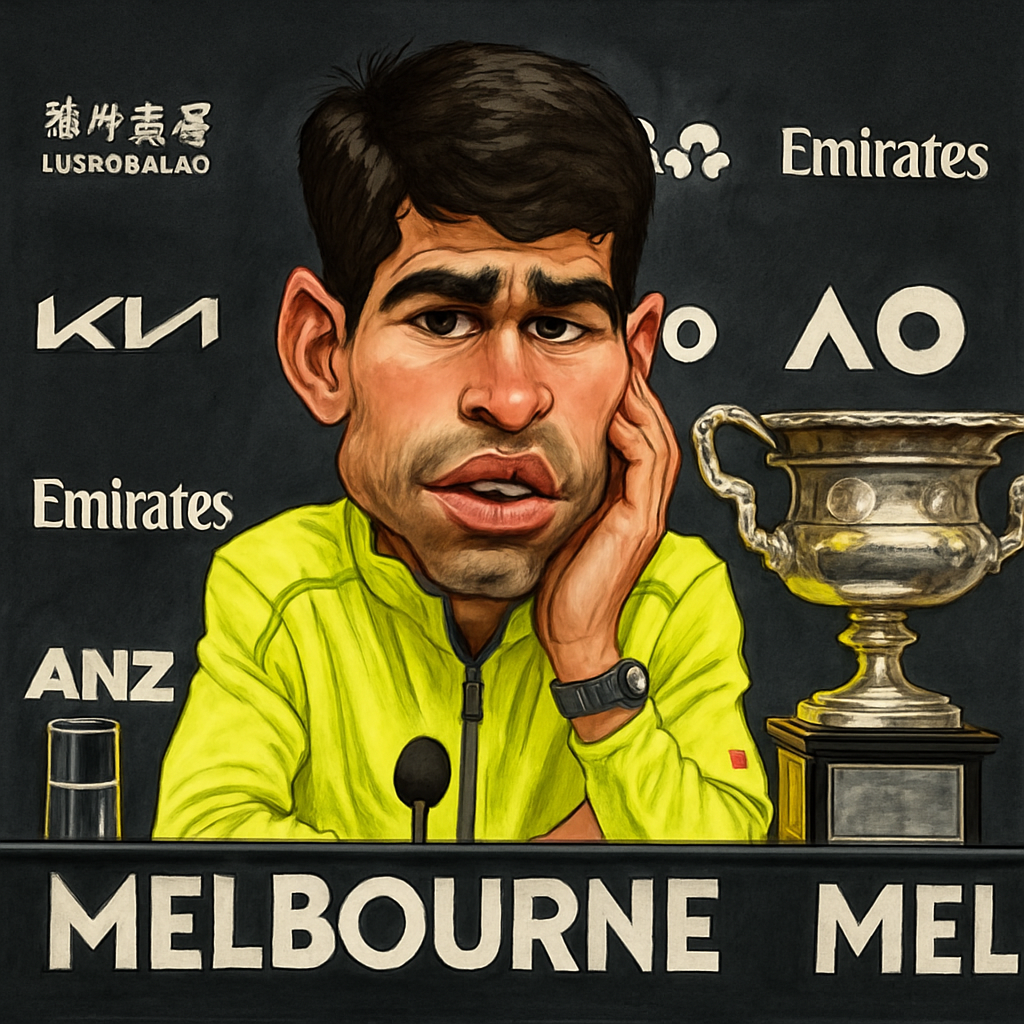
MELBOURNE — In the afterglow of his triumphant Australian Open victory, a moment that cemented his status as the sport's new global superstar, Carlos Alcaraz finds himself navigating a complex and emotional off-court situation. The focus has shifted from his breathtaking tennis to the departure of his coach, Juan Carlos Ferrero, a split now clouded by allegations of unprofessional behavior from Ferrero's subsequent employer.
Alcaraz, who defeated Daniil Medvedev in a thrilling final to claim his third Grand Slam title, had been working without Ferrero in Melbourne. The former world No. 1 and 2003 French Open champion was absent due to knee surgery recovery. In his stead, Alcaraz was guided by his other coach, Samuel López. The team's success in Ferrero's absence raised immediate questions about the dynamics within the camp, questions that have now been thrust into the spotlight in a startling manner.
The Academy's Stunning Accusations
The controversy erupted when the Equelite Ferrero Tennis Academy, founded by Juan Carlos's father and where Ferrero himself is a director, issued a public statement. The academy announced Ferrero's departure and, in an unusually blunt move, detailed the reasons for the split. They accused Ferrero of a pattern of behavior they deemed incompatible with the institution's values, stating his actions had created a "sad situation" for all involved.
The academy's release was scathing. It claimed Ferrero had "systematically and repeatedly failed to comply with his contractual obligations as director of the high-performance area" and had engaged in "continuous disrespect towards the company's staff, clients, and suppliers." Furthermore, they alleged he used the academy's facilities and reputation for his personal projects without authorization, creating an untenable work environment.
Ferrero's Integral Role in the Alcaraz Project
To understand the gravity of these accusations, one must appreciate Ferrero's foundational role in Alcaraz's career. He is not just a coach; he is the architect. Ferrero took on a raw, 15-year-old Alcaraz, moving him from Murcia to the Equelite Academy and molding him into a champion. Their relationship has been described as father-son, with Ferrero's technical expertise and competitive fire directly imprinting on Alcaraz's explosive, all-court style.
Key elements Ferrero instilled in Alcaraz include:
- A relentless, physical baseline game combined with sublime touch at the net.
- A fearless competitive mentality, encouraging constant aggression.
- The emotional maturity to handle the pressures of the tour from a young age.
- The strategic versatility to win on all surfaces.
This deep history makes the academy's public rebuke not just a business matter, but a personal and professional rift within the very ecosystem that created the world No. 2. It places Alcaraz in an awkward position, loyal to his mentor but undoubtedly connected to the academy that has been his training home.
Alcaraz's Diplomatic Response and Future Uncertainty
When questioned about the situation after his Australian Open win, Alcaraz handled it with the poise of a seasoned veteran, but his words hinted at the underlying difficulty. "It's a sad situation, honestly," he admitted, echoing the academy's own phrasing. "For me, it's a bit difficult to talk about that. I don't know the 100% of the situation... I only know the news from the academy. I don't know his part. I'm going to talk to him soon."
This careful neutrality underscores Alcaraz's predicament. He has not defended Ferrero against the specific allegations, nor has he criticized the academy. His priority, stated clearly, is his tennis. "I'm going to stay out of it. I have enough to focus on my season, my goals. I don't want to lose energy on things I can't control," he told the press.
However, the situation raises practical questions about Alcaraz's future training base. The Equelite Academy in Villena has been his physical and technical headquarters for years. If the rift with the Ferrero family is irreparable, does Alcaraz seek a new primary training facility? Furthermore, how does this public dispute affect the day-to-day trust and focus within the player-coach relationship, which is built on mutual respect and a shared vision?
The Shadow Over a Historic Victory
The timing of the academy's statement, coming just as Alcaraz was celebrating the pinnacle of his young career, has been viewed by many in the tennis world as poor form. It risked overshadowing his historic achievement—becoming the youngest man in the Open Era to win Grand Slams on grass, clay, and hard courts. Instead of a pure celebration, the narrative became bifurcated between on-court glory and off-court drama.
Tennis pundits have expressed sympathy for Alcaraz. Former player and analyst Brad Gilbert noted, "It's the last thing a player needs after winning a major. Your team should be your sanctuary, the place where all the outside noise stops. For Carlos, that noise just got a lot louder right when he should be basking in the achievement."
A Test of Resilience and Focus
As of now, the professional relationship between Alcaraz and Ferrero appears intact. Ferrero is expected to rejoin the tour once fully recovered. The true test will be how they compartmentalize this very public family and business dispute from their work together. For Alcaraz, whose greatest strengths are his joyful energy and focused intensity, managing this "sad situation" may be his next great challenge.
The episode serves as a stark reminder that even in the individual sport of tennis, success is a team effort, and that team can be fragile. Carlos Alcaraz's 2024 season began with the ultimate high in Melbourne. The path forward now requires him to navigate an unexpected and personal low, proving his champion's mentality extends far beyond the painted lines of a tennis court.