
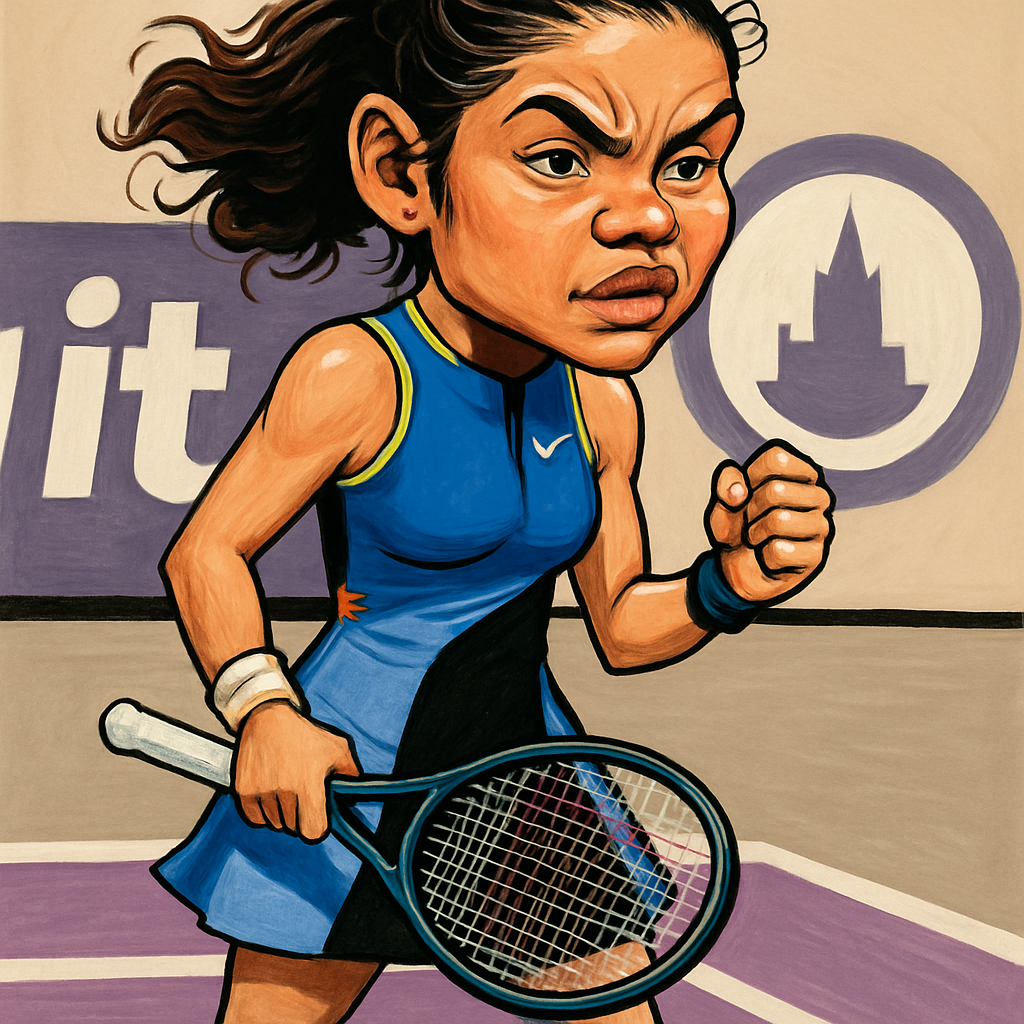
CLUJ-NAPOCA — The tennis world is rarely short of strong opinions, but when six-time Grand Slam champion Boris Becker speaks, the sport tends to listen. His recent, brutally succinct assessment of Emma Raducanu’s current standing has sent shockwaves through the tennis community, cutting to the heart of the young Briton’s challenging journey since her historic 2021 US Open triumph.
Becker, a former world No. 1 and now a prominent pundit, was discussing the landscape of women’s tennis on the Eurosport podcast ‘Das Gelbe vom Ball’ when the topic turned to Raducanu. In a stark departure from the often-protective narrative surrounding the 21-year-old, Becker delivered a two-word verdict on her current status: “She’s gone.”
The Context: A Fall From the Summit
To understand the weight of Becker’s words, one must recall the unprecedented nature of Raducanu’s rise. In 2021, as an 18-year-old qualifier ranked 150th in the world, she captured the US Open title without dropping a single set, a feat never before accomplished in the Open Era. Overnight, she became a global superstar, gracing magazine covers and signing lucrative endorsement deals. However, the trajectory since has been defined not by trophies, but by a relentless battle with injuries and inconsistency.
A revolving door of coaches, multiple surgical procedures on her wrists and ankle, and extended periods away from the tour have stalled her momentum. Her ranking, which once peaked at No. 10, has plummeted outside the top 300, forcing her to rely on wildcards or compete at lower-level tournaments to rebuild. It was at one such event, the Transylvania Open in Cluj-Napoca, where Becker’s comments found their immediate backdrop.
Becker’s Blunt Analysis Explained
Becker’s point was not that Raducanu has retired, but that she has effectively disappeared from the elite conversation. “That’s the harsh reality of professional sport,” he elaborated. “Emma Raducanu won the US Open two and a half years ago, was then in the top ten, and now she’s outside the top 300. She’s playing in Cluj this week, but who talks about Emma Raducanu anymore? She’s gone.” His critique centers on the fickle nature of sporting fame and the difficulty of maintaining a place in the spotlight without consistent results at the highest level.
The German legend contrasted her situation with that of other young stars who have sustained success, noting, “We are talking about [Coco] Gauff, [Jasmine] Paolini, [Qinwen] Zheng. These are the players of the present and the future, not Emma Raducanu.” For Becker, the narrative has decisively moved on.
Raducanu in Cluj: A Glimmer of Hope?
Ironically, as Becker’s words circulated, Raducanu was quietly crafting her most promising run in months at the very tournament he referenced. Seeded eighth in Cluj, she displayed flashes of her brilliant best:
- A commanding first-round victory over Romanian wildcard Ana Bogdan.
- A resilient, three-set comeback win against world No. 82 Nuria Parrizas Diaz in the second round.
- A dominant performance against Ukrainian qualifier Daria Snigur to reach the quarterfinals.
This streak marked her first WTA-level quarterfinal since April 2023, a small but significant milestone in her arduous comeback. Her play in Romania showcased the clean ball-striking and tactical intelligence that made her a champion, suggesting the talent is very much still there, even if the ranking and consistent results are not.
The Quarterfinal Hurdle
The run, however, came to a halt in the last eight against the experienced former top-20 player, Ana Bogdan (in a different match from her first round). Despite fighting hard, Raducanu fell in straight sets. Yet, her post-tournament reflection was notably positive and forward-looking. “I’m very proud of how I fought this week,” she stated. “It’s a big step for me from where I was a month ago. I’m just looking forward to putting more work in and continuing this process.”
The Road Ahead and the Weight of Expectation
Becker’s comments, however harsh, underscore a critical challenge for Raducanu: transcending the label of a one-Slam wonder and reclaiming a permanent seat at tennis’s top table. The sport’s ecosystem is unforgiving, with new stories and stars emerging weekly. Her immediate focus is on the Middle East swing, where she will need to continue accumulating points and match sharpness.
The debate her situation sparks is multifaceted. Is Becker’s assessment a necessary dose of reality, highlighting the brutal competitiveness of the tour? Or is it prematurely writing off a still-young athlete who has faced extraordinary physical and psychological pressures since her breakthrough? Many argue that Raducanu’s story is one of long-term rehabilitation, not immediate decline, and that patience is required.
Conclusion: Gone or Merely Gathering?
Boris Becker’s “she’s gone” message is a brutal but potent commentary on how quickly narratives can shift in professional tennis. It reflects the reality that past glory offers no guarantees. Yet, Raducanu’s determined showing in Cluj, and her mature perspective afterward, suggests a player who is far from finished. The coming months will be telling. Is she the faded star Becker describes, or a champion in remission, patiently plotting a return that could make her second act as compelling as her first? For now, Emma Raducanu is not gone from the court; she is in the trenches, fighting to ensure that the next time the tennis world talks about her, it is for what she is achieving in the present, not just what she accomplished in the past.