
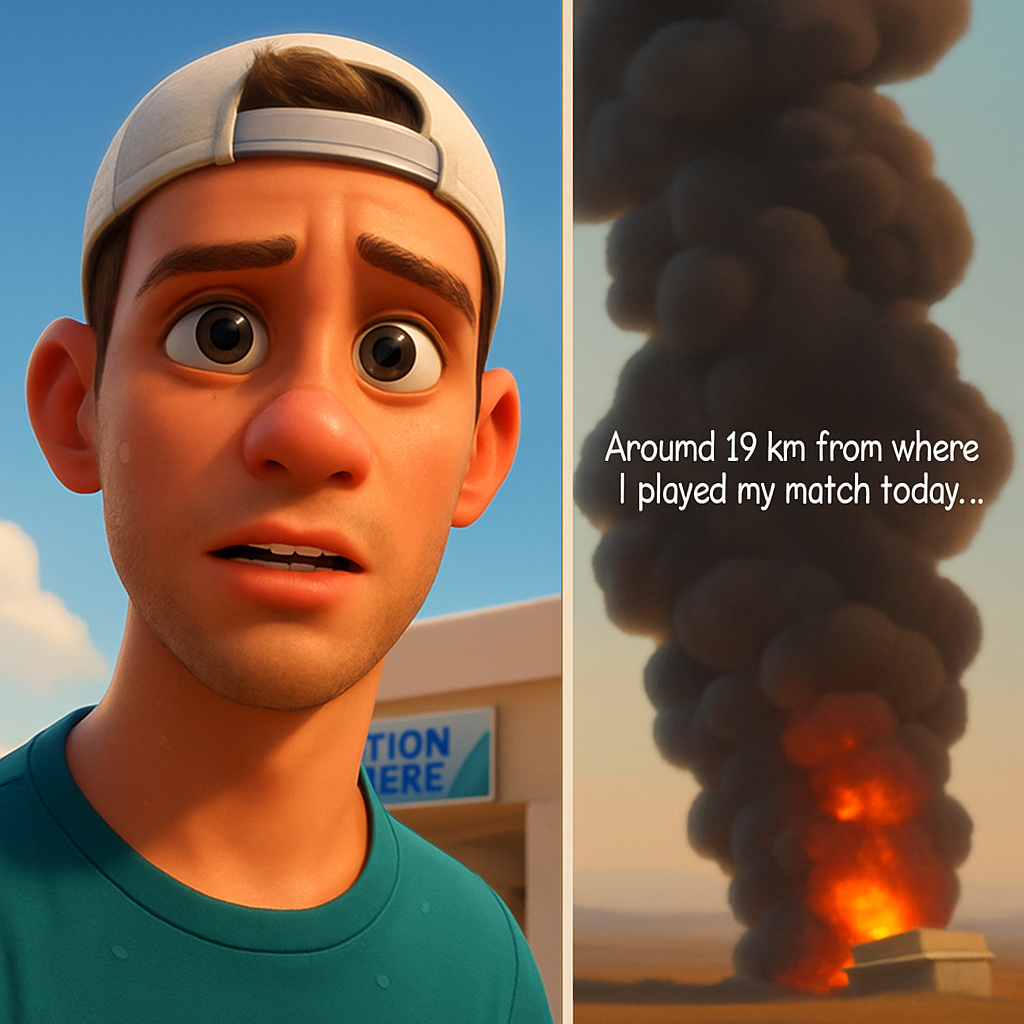
FUJAIRAH — The serene atmosphere of a professional tennis tournament in the United Arab Emirates was shattered this week by a frightening security breach, as a drone flew alarmingly close to the court, forcing the immediate evacuation of players and spectators. The incident, which occurred during the Fujairah Tennis and Squash Complex's ITF World Tennis Tour M15 event, left Ukrainian player Vladyslav Orlov visibly shaken and prompted him to voice his fears publicly on social media.
Orlov, a 23-year-old Ukrainian, was competing in his quarterfinal match against Russian player Maxim Zhukov when the unauthorized drone appeared overhead. Tournament officials, citing strict local regulations and safety protocols, swiftly halted play and cleared the outdoor hard courts. The abrupt interruption and the perceived threat of the unmanned aerial vehicle left Orlov feeling profoundly unsafe in a region generally known for its stability and security.
A Terrifying Interruption on Court
The Fujairah tournament is part of the International Tennis Federation's lower-tier professional circuit, where players grind for ranking points and prize money. For Orlov, ranked in the 700s, every match is a critical opportunity. The match against Zhukov was tightly contested when the drone's buzzing became audible, circling the complex in a manner described by witnesses as erratic and intrusive. Security personnel acted quickly, but the damage to the players' sense of security was already done.
In a heartfelt post on his Instagram stories, Orlov did not mince words about his experience. "I was scared," he wrote. "We were evacuated from the match because of a drone. I don't feel safe here in Fujairah." His message, accompanied by a photo of the empty court, highlighted the stark contrast between the expected focus of athletic competition and the sudden onset of real-world anxiety.
The Broader Context of Drone Threats in the UAE
While drone incidents at sporting events are rare, they are taken with the utmost seriousness in the UAE. The country has experienced targeted drone attacks by Yemen's Houthi rebels in recent years, primarily aimed at critical infrastructure in Abu Dhabi and Dubai. Fujairah, an emirate on the Gulf of Oman known for its port and quieter profile, has not been a frequent target. However, the nation's airspace regulations are exceptionally strict as a result.
The UAE's General Civil Aviation Authority (GCAA) enforces rigorous rules for drone operation, requiring permits for most activities and prohibiting flight near sensitive areas, which include airports, palaces, and major public gatherings. An unauthorized drone at a public sporting event would trigger an immediate and severe response. The key questions following the incident include:
- Was the drone a hobbyist's reckless mistake, or was it a deliberate act of disruption?
- Given the geopolitical tensions in the region, could it have been a probing security test?
- How did it penetrate the security perimeter of the tournament venue?
Local authorities have launched an investigation to locate the operator, but as of now, no public statements have identified a suspect or a motive. The ITF and tournament organizers have deferred all comments to the local police, emphasizing that player safety is the paramount concern.
Player Reactions and the Aftermath
For Vladyslav Orlov, the incident was compounded by his personal context as a Ukrainian athlete. The ongoing war in his homeland, frequently characterized by drone warfare, adds a deeply personal layer of trauma. "When you hear a drone, your mind immediately goes to the worst places," he later elaborated in comments to Ukrainian media. The match against a Russian opponent, already a politically and emotionally charged dynamic for Ukrainian athletes, was made exponentially more stressful by the external threat.
The tournament was suspended for several hours as security sweeps were conducted. When play resumed, Orlov returned to court but lost the match to Zhukov in three sets. Fellow players expressed solidarity with Orlov online, sharing his posts and echoing concerns about safety. The incident has sparked a wider conversation on the professional tennis tour about security protocols at smaller venues, which often lack the robust, multi-layered security of ATP or WTA Tour events.
A Pattern of Security Concerns in Tennis
This is not the first time an external security threat has disrupted a tennis match. In recent years, the sport has grappled with various challenges:
- Environmental protests have interrupted play at Grand Slams, with activists glueing themselves to the court.
- A major security scare at the 2022 ATP Finals in Turin involved a suspected bomb threat, leading to an evacuation.
- The WTA's continued dealings with the safety of Chinese player Peng Shuai highlighted political dimensions of player security.
However, a drone incursion represents a newer, more technologically advanced threat. Drones can be difficult to detect and disable quickly, and their potential payload—whether merely observational or something more sinister—creates a significant risk management challenge for event organizers worldwide.
Conclusion: Safety First in an Unpredictable World
The frightening episode in Fujairah serves as a stark reminder that global sporting events do not exist in a bubble. They are subject to the same geopolitical tensions and security vulnerabilities as any other large gathering. For athletes like Vladyslav Orlov, the court is a workplace, and the fundamental expectation of physical safety was, in his view, violated.
While the investigation continues, the tennis world is left to ponder the adequacy of its security measures at all levels of the game. The ITF and local organizers will undoubtedly review and strengthen protocols for future events in the region. As Orlov's candid admission showed, the psychological impact of such incidents can be as debilitating as any physical injury. "We are here to play tennis, not to hide from drones," he stated, a simple yet powerful plea for the sanctity and security of the sporting arena. In an era where technology and conflict increasingly intrude on all aspects of life, ensuring that safety is the ultimate priority remains the most pressing challenge for the guardians of the game.