
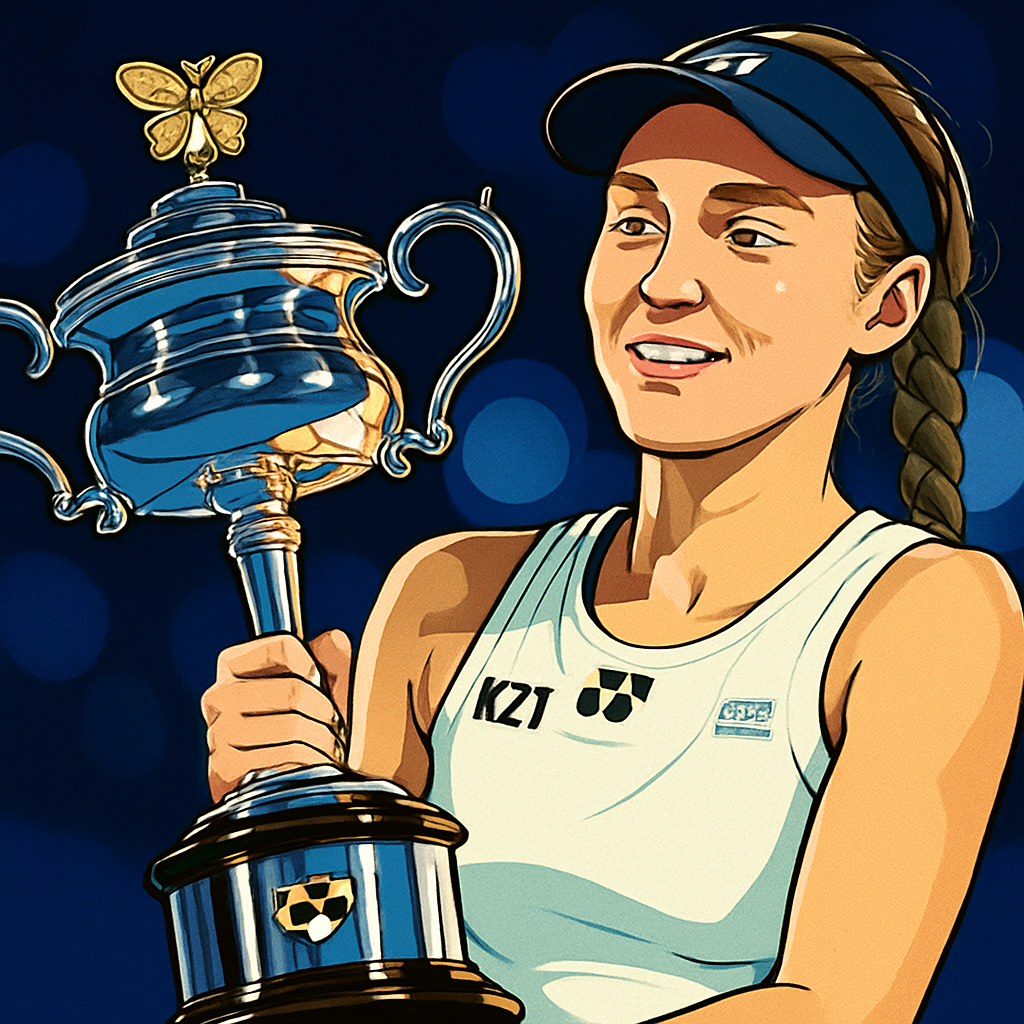
MELBOURNE — Under the closed roof of Rod Laver Arena, a storm of power tennis raged for over two and a half hours. When the final, thunderous forehand winner crashed past Aryna Sabalenka, Elena Rybakina stood motionless, a portrait of serene disbelief. The 23-year-old had just inflicted further Grand Slam final heartbreak on her formidable opponent, mounting a stunning third-set fightback to claim her first Australian Open title with a 4-6, 6-3, 6-4 victory.
This was a final that transcended the typical narrative of a championship match. It was a clash of titans, a battle between the two most fearsome ball-strikers in the women's game, where rallies were often brutally short but every point carried seismic weight. For Rybakina, the reigning Wimbledon champion, it was a validation of her major-winning pedigree on a stage where she was not the favorite. For Sabalenka, who had been utterly dominant all tournament without dropping a set, it was a cruel repeat of her 2023 U.S. Open final loss, another three-set defeat where victory had seemed within her formidable grasp.
A Clash of Styles and Nerves
The match began as many predicted, with Sabalenka’s raw power and aggressive intent threatening to overwhelm. She broke Rybakina’s serve in the very first game, setting a tone of relentless pressure. Her groundstrokes, particularly her rebuilt forehand, were missiles aimed at the corners. Rybakina, by contrast, started tentatively, her usually reliable serve misfiring and her movement appearing sluggish. Sabalenka sealed the first set 6-4, and the momentum seemed firmly in the Belarusian's corner. "I started a bit slow," Rybakina admitted later.
Yet, the subtle shift began in the second set. Rybakina, the ice to Sabalenka’s fire, began to find her range. The key elements of her game that had carried her to the Wimbledon title re-emerged:
- The Serve: Her first-serve percentage climbed, and she began firing unreturnable bombs, finishing with 9 aces to Sabalenka's 17 but winning a crucial 70% of points behind her first serve.
- The Forehand: She started unleashing her own weapon off the wing, redirecting Sabalenka’s pace with interest and finding breathtaking angles.
- The Composure: While Sabalenka’s error count began to creep up under the mounting pressure, Rybakina’s impassive demeanor never cracked.
Breaking Sabalenka early in the second, Rybakina leveled the match at one set apiece, transforming the final into a one-set shootout for the Daphne Akhurst Memorial Cup.
The Decisive Fightback
The third set was a masterpiece of tension and high-quality tennis. Sabalenka, refusing to wilt, broke immediately to surge ahead 2-0. The title appeared to be slipping from Rybakina’s grasp. But in what became the defining passage of the match, the Kazakhstani player displayed champion’s resolve. She broke straight back, and then, in a monumental sixth game featuring multiple deuces and break points, she broke Sabalenka again to take a 4-3 lead. "I was just trying to focus on every point," Rybakina said of her comeback.
Serving for the championship at 5-4, Rybakina did not falter. At 30-30, she produced a stunning cross-court backhand winner, a shot she later called the best of her life. On her first championship point, she fittingly ended the contest with a clean, crushing forehand winner. Sabalenka, who had fought so valiantly, could only watch it fly past. The final stats were remarkably close, but Rybakina had won the points that mattered most.
By the Numbers: A Statistical Standoff
The scoreboard told a story of razor-thin margins. Sabalenka actually hit more winners (51 to 31) and more aces (17 to 9). However, Rybakina’s greater consistency proved decisive. Sabalenka committed 28 unforced errors in the second and third sets combined, a number that skyrocketed under the pressure applied by Rybakina’s relentless depth. Rybakina, meanwhile, converted 3 of her 7 break points, while saving 8 of the 11 she faced on her own serve, a testament to her clutch performance in critical moments.
Quotes from the Champions
In the aftermath, both players displayed immense grace. A devastated but gracious Sabalenka paid tribute to her opponent: "Congratulations to Elena. You're an incredible player and of course we are going to fight for many more trophies. I hope next time it's going to be a bit better for me." She also hinted at the mental battle, vowing, "I just have to work a little bit harder so I feel a little bit better in those moments."
Rybakina, holding the trophy aloft, reflected on her incredible journey over the past year. "I want to congratulate Aryna on a great tournament and a great start to the season. I know how hard you work and hopefully we are going to have many more battles." On her own resilience, she added, "I was super nervous before the match, during the match. I'm just happy that in the end I managed my emotions and I fought for every point."
A New Chapter in a Growing Rivalry
This final has undoubtedly cemented the Rybakina-Sabalenka rivalry as the premier clash in women's tennis. Their styles are perfectly contrasting, their power is unparalleled, and their meetings are consistently dramatic. With this victory, Rybakina not only collects her second Grand Slam title but also makes a monumental leap to World No. 4 in the rankings, proving her Wimbledon win was no fluke. She becomes the first player since Victoria Azarenka in 2013 to win the Australian Open after losing the first set in the final.
For Sabalenka, the quest for a second major continues, marked by another agonizingly close defeat. Yet, her transformed serve and improved mental fortitude throughout this tournament signal that she will remain a dominant force. The 2024 Australian Open final was more than a match; it was a statement. It announced that the power era in women's tennis is in full swing, and at its forefront are two champions: Elena Rybakina, the cool-headed assassin, and Aryna Sabalenka, the relentless powerhouse. Their battle under the Melbourne lights was an instant classic, and as Rybakina hoisted the trophy, it was clear this was just the latest chapter in what promises to be a defining rivalry for years to come.