
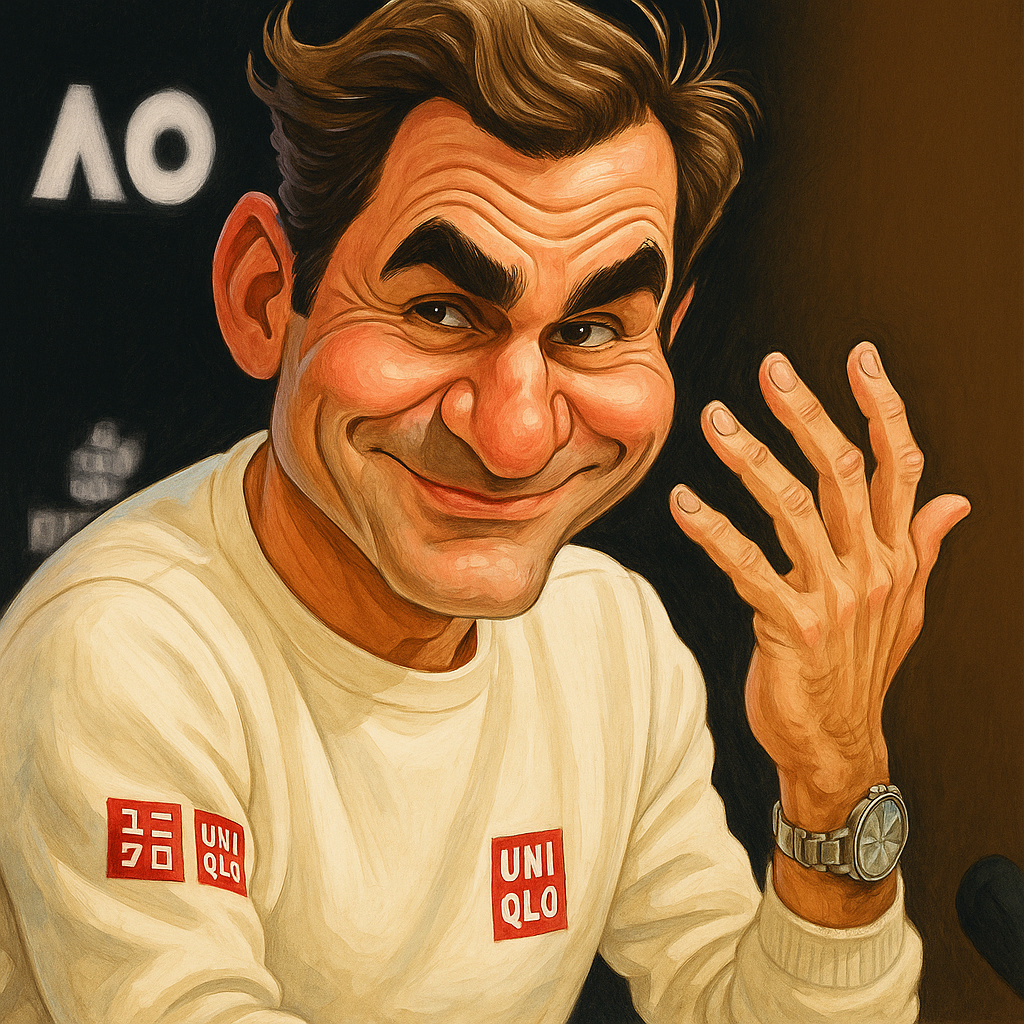
PARIS — In the ever-evolving and fiercely debated landscape of men's tennis' "Greatest of All Time" (GOAT) conversation, a new and provocative voice has emerged. Former Grand Slam champion and current commentator Mats Wilander has delivered a brutal verdict, suggesting that the legendary Roger Federer is being left behind in the collective memory of the sport, overshadowed by the ongoing epic rivalry between Novak Djokovic and Rafael Nadal.
Wilander, a seven-time major winner himself, made the comments in a recent interview, casting a stark light on the rapid pace of change in tennis narratives. "It feels like Roger Federer is already forgotten about," Wilander stated bluntly. "It’s quite incredible that a player as successful as Roger, who we all love, can actually be forgotten about in the middle of a match at the French Open or at any tournament."
The Shadow of the Present Rivalry
Wilander's central argument hinges on the intensity of the current sporting context. While Federer retired in September 2022, the Djokovic-Nadal saga continues to write new chapters, particularly with Nadal's emotional farewell at Roland-Garros this year and Djokovic's relentless pursuit of further history. This, Wilander suggests, actively pushes Federer's legacy to the periphery for fans and commentators in the heat of the moment. "We’re so involved in what’s going on with Novak and Rafa," he explained. "Every time they play, we’re like, ‘This is the greatest match we’ve ever seen.’ And then we forget about the other matches that were the greatest we’ve ever seen that involved Roger Federer."
The Swede pointed to specific instances, such as the iconic 2022 Wimbledon final where Novak Djokovic came back to defeat Nick Kyrgios. "We watch Novak against Kyrgios in the Wimbledon final two years ago, and we go, ‘Oh my God, this is one of the greatest matches of all time.’ And we forget that Roger was involved in two of the greatest Wimbledon finals of all time [against Nadal in 2008 and against Djokovic in 2019]."
A Legacy of Numbers and Aesthetics
To contextualize Wilander's provocative claim, one must first acknowledge the staggering weight of Federer's achievements, which make the notion of him being "forgotten" so jarring:
- 20 Grand Slam titles: A record at the time of his retirement, now surpassed by both Nadal (22) and Djokovic (24).
- 310 weeks at World No. 1: A record later broken by Djokovic.
- 6 ATP Finals titles: A shared record.
- 28 Masters 1000 titles and an Olympic gold medal in doubles.
Beyond the statistics, Federer's legacy is inextricably tied to the sheer beauty and effortless grace of his game. His style revolutionized men's tennis, combining powerful, precise shot-making with a balletic movement that made the extraordinarily difficult look simple. For a generation of fans and players, he was the archetype of tennis excellence.
The Statistical Recalibration
However, the latter stages of Federer's career coincided with the statistical dominance of his two great rivals. The GOAT debate, once centered on Federer's then-record 17 majors, has been fundamentally recalibrated by Nadal's clay-court hegemony and, most decisively, by Djokovic's all-surface mastery and record-breaking 24th major. Wilander's comments speak less to a dismissal of Federer's greatness and more to the cold, hard focus of the sporting world on current records and active rivalries.
Fan and Pundit Reaction
Unsurprisingly, Wilander's remarks have ignited a firestorm of reaction across social media and tennis forums. Many fans have vehemently disagreed, arguing that Federer's impact transcends mere statistics and that his cultural significance as a global sporting icon ensures his legacy is permanent. Others, however, concede a kernel of truth in Wilander's observation, noting the natural tendency of sports media to focus on the narratives of the present.
Fellow analysts have weighed in with nuance. While acknowledging the power of the Djokovic-Nadal narrative, they often counter that Federer's role as the catalyst for this golden era is never truly forgotten. "Roger was the standard," one prominent broadcaster noted. "He was the mountain Nadal and Djokovic had to climb. You can't tell the story of their greatness without starting with his."
The Nature of Sporting Memory
Wilander's commentary ultimately touches on a deeper philosophical question about sports legacy. Is greatness measured solely by the enduring, unchallenged pinnacle of records, or is it also subject to the fading echo of applause once the athlete leaves the stage? In an era where Djokovic is still adding to an unprecedented resume and Nadal's fighting spirit is being celebrated in a long farewell, Federer's absence from the court may, as Wilander suggests, create a temporary distance.
Yet, to say Federer is "forgotten" is likely an exaggeration designed to provoke discussion. A more accurate assessment might be that his legacy is in a state of transition—from the defining champion of his time to a foundational pillar of the sport's history. His records may have been surpassed, but his influence on technique, professionalism, and the global popularity of tennis remains indelible.
Conclusion: An Unforgettable Catalyst
Mats Wilander's "brutal verdict" serves as a stark reminder of sport's relentless forward momentum. While the spotlight rightly shines on Novak Djokovic's historic achievements and Rafael Nadal's enduring passion, it would be a profound error to interpret this focus as amnesia. Roger Federer, with his 20 major titles and era-defining elegance, is not forgotten. He is the benchmark against which the current rivalry was forged. He is the player who made millions fall in love with the sport. His legacy is not being erased; it is being contextualized as the first and perhaps most elegant act in the greatest story men's tennis has ever told.