
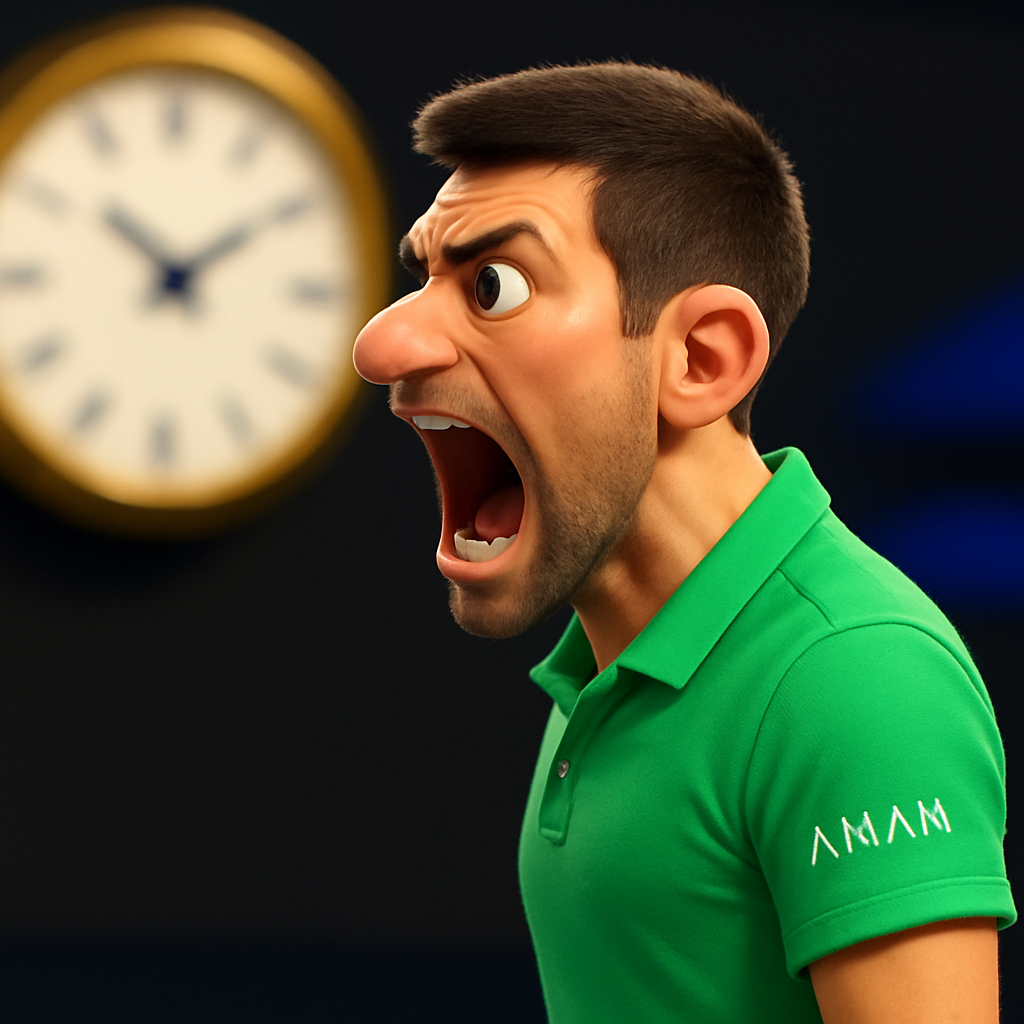
MELBOURNE — The serene, sun-drenched courts of Melbourne Park were the stage for a moment of high tension on Friday night, as world No. 1 Novak Djokovic found himself in an uncharacteristic battle, both with his opponent and his own emotions. During a fraught third-round match against 30th seed Tomáš Macháč, Djokovic’s frustrations boiled over in a manner that sent a ripple of concern through Rod Laver Arena, nearly resulting in a ball girl being struck by an angry, misdirected shot.
The incident occurred late in the third set, with Djokovic trailing two sets to one and locked in a grueling baseline exchange. After being wrong-footed by a sharp Macháč forehand, Djokovic, visibly exasperated, turned and smashed the ball with considerable force towards the back of the court. The ball ricocheted off the advertising hoarding at high speed, narrowly missing a ball girl stationed nearby, who flinched as it whistled past. Djokovic immediately raised his hand in a gesture of apology, his expression shifting from anger to remorse.
A Night of Uncharacteristic Struggle
Djokovic’s 6-3, 7-6(4), 4-6, 6-0 victory over the talented Czech was far from the straightforward progression expected of the 10-time Australian Open champion. From the outset, he appeared physically below par, struggling with movement and timing. The usually impenetrable Serb was broken early, made unforced errors in clusters, and frequently gestured towards his team and box with a look of bewilderment. The near-miss with the ball girl was the most visible symptom of a deeper frustration that permeated his performance for much of the first three sets.
In his post-match press conference, Djokovic was quick to address the moment, expressing profound relief that the ball girl was unharmed. "I want to apologize to the ball girl," he stated earnestly. "It was a very unfortunate reaction from me in the heat of the battle. I was going for a change of ends and just let my frustration get the better of me. Of course, I didn’t want to hit her, and thank God she is okay."
Physical Concerns and Mental Fortitude
Speculation about Djokovic’s physical condition was rife throughout the match. He required a medical timeout after the first set and was seen stretching his upper leg and torso. While he downplayed any serious injury, he admitted to feeling "under the weather" and not at his peak. "I’m still trying to find the form, especially in the early part of the tournament," he conceded. "You have to accept it, navigate through it, and find a way to win. That’s what I did tonight."
This internal battle manifested in several ways throughout the nearly four-hour contest:
- Unforced Errors: Djokovic committed 49 unforced errors, a strikingly high number for a player of his precision.
- Body Language: Frequent sighs, conversations with his box, and slumped shoulders replaced his typical aura of icy focus.
- Resilience: Despite the struggles, his champion’s mentality surfaced in the crucial second-set tiebreak and a dominant, bagel fourth set to close the match.
The Turning Point and Regained Control
The match’s pivotal shift came after the tense third set and the concerning incident. Seemingly channeling his frustration into pure focus, Djokovic emerged for the fourth set a transformed player. He began moving more freely, striking the ball with cleaner timing, and applying relentless pressure on Macháč’s serve. The 6-0 scoreline in the decider was a stark reminder of his ability to flip a switch and elevate his game when most needed, a trait that has defined his career.
Tennis analysts and former players were quick to dissect the event. While universally praising his immediate apology, many noted the rarity of such a loss of composure from the 24-time Grand Slam champion. "It was a scary moment," said commentator and former player Jim Courier. "Novak is usually so controlled. It shows you just how much he was wrestling with himself out there. The apology was instant and sincere, but it’s a reminder of the fine line these athletes walk in moments of extreme pressure."
Broader Context and Tournament Ramifications
The incident inevitably draws comparisons to past moments of on-court frustration from top players, though Djokovic has largely avoided such controversies in recent years. It also raises questions about his form and fitness as he pursues an unprecedented 11th Australian Open title and a 25th major crown. His path does not get easier, with a fourth-round clash against the powerful 20th seed, Adrian Mannarino, looming.
For the ball girl, the tournament organizers confirmed she was checked by medical staff and was fine, continuing her duties for the remainder of the session. The episode serves as a potent reminder of the human element in professional sport—the immense pressure, the fleeting loss of control, and the importance of accountability. Djokovic’s ability to reset after the incident and close out the match demonstrates the mental fortitude that separates the great from the good, but the night will be remembered for a moment where that fortitude briefly cracked, with potentially serious consequences.
As the tournament progresses, all eyes will be on how Djokovic manages both his game and his emotions. The champion acknowledged the lesson, stating, "I have to be better in managing my emotions on the court. It’s a part of the sport, but it’s never an excuse." For a player whose legacy is built on relentless control, Friday night in Melbourne was a stark, humanizing deviation from the script.