
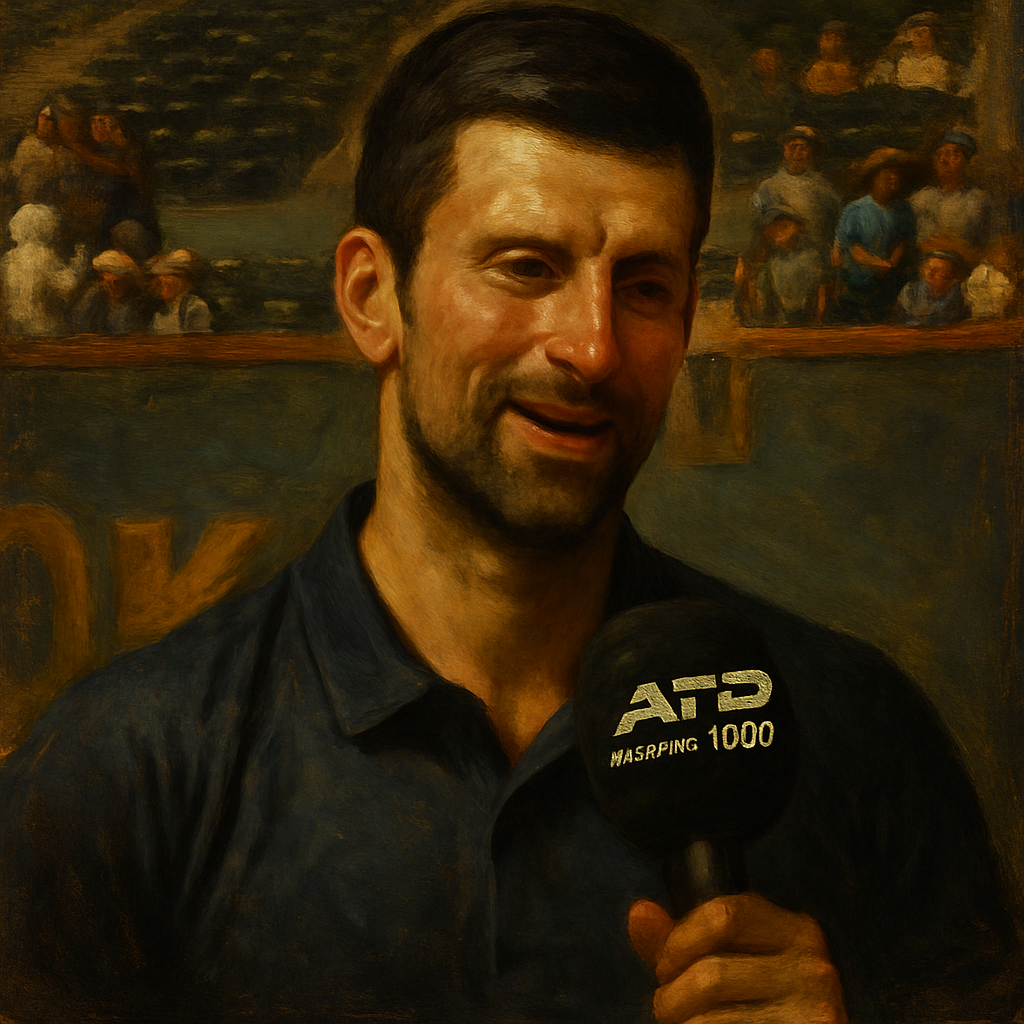
PARIS — In a startlingly candid admission that cut through the usual platitudes of professional sport, Novak Djokovic revealed a profound struggle with his own motivation and joy on the tennis court following a hard-fought victory at the 2024 French Open. The world No. 1, a 24-time Grand Slam champion known for his relentless mental fortitude, confessed, "I'm not enjoying myself" in a brutally honest post-match interview that has sent ripples through the tennis world.
Djokovic’s comments came after a grueling four-set battle against unseeded American Aleksandar Kovacevic in the first round at Roland Garros. While the 6-4, 6-7(6), 7-6(5), 6-2 scoreline ultimately reflected his victory, the performance was a far cry from the clinical dominance fans have come to expect. The Serbian superstar appeared frustrated, flat, and at times visibly angry with himself, battling not just his 25-year-old opponent but an internal conflict that has seemingly plagued his 2024 season.
A Grind Against Kovacevic and Inner Demons
The match itself was a microcosm of Djokovic’s current state. Facing a player ranked 114th in the world and making his Grand Slam main-draw debut, Djokovic was expected to cruise. Instead, he found himself in a dogfight. Kovacevic, playing with fearless aggression and nothing to lose, pushed the legend to the brink, seizing the second set in a tiebreak and forcing a third-set tiebreak where Djokovic’s experience narrowly prevailed. The champion’s relief at the end was palpable, but it was tinged with exhaustion and dissatisfaction.
In his on-court interview, the mask of invincibility slipped. "A win is a win. I'm happy to get through, especially in four sets," he began, before delving into the raw truth. "But the way I felt on the court, the way I played... I'm not enjoying myself. It's really, really hard to find that joy on the court at the moment. I'm trying to find that old feeling, that spark, but it's not there."
Dissecting the "Why": A Perfect Storm of Factors
For an athlete who has built a career on finding joy in the struggle and peaking for the biggest stages, this admission is significant. Analysts and fans have pointed to a confluence of factors that may be contributing to this unprecedented dip in morale and form for the 37-year-old:
- A Challenging Season Start: 2024 has been Djokovic’s slowest start in nearly a decade. He is yet to win a title this year, has a modest 14-6 record, and suffered surprising early exits at the Australian Open (semi-finals) and in tournaments like Indian Wells and Rome.
- Physical and Scheduling Nuances: At 37, recovery is different. He has played a lighter schedule, which can sometimes make it harder to find competitive rhythm. Furthermore, the absence of his long-time coach, Goran Ivanisevic, with whom he parted ways in March, has left a noticeable void in his team dynamics.
- The Weight of History: The perpetual pressure to make history—whether extending his Grand Slam record or reclaiming the World No. 1 ranking he recently lost to Jannik Sinner—is a unique burden only he carries.
- Evolving Competition: The rise of a fearless, powerful new generation, exemplified by Sinner and Carlos Alcaraz, means there are no easy matches, even in early rounds, adding to the mental toll.
Djokovic himself hinted at this complex web of pressures. "When you're expected to win every match, when anything less than a title is seen as a failure, it creates a different kind of stress," he explained. "The target on my back is bigger than ever. And sometimes, the process of getting there, the day-to-day grind, loses its color."
The Search for the "Spark"
What makes Djokovic’s confession so compelling is his self-awareness. He isn’t simply complaining; he is diagnosing a problem he is desperate to solve. He spoke of the "spark"—that intrinsic motivation and love for competition that has fueled his two-decade career. Finding it again, he admitted, is his current greatest challenge, more daunting than any opponent across the net.
"The technical things, the fitness, I can work on those. They are clear," he said. "But the love for the battle, the pure happiness of hitting a tennis ball in a big stadium... that's a feeling. It's not something you can force. You have to reconnect with it. And right now, I feel disconnected." This search for emotional reconnection is a stark contrast to the machine-like persona often associated with his game.
Reactions from the Tennis Community
The tennis world reacted with a mix of surprise, sympathy, and respect for his honesty. Former players noted that such phases are almost inevitable in a career as long and taxing as Djokovic’s. Rivals, while undoubtedly seeing an opportunity, acknowledged the mental fortitude it takes to publicly acknowledge such vulnerability while still competing at the highest level.
Tennis legend John McEnroe commented in analysis, "We've seen this before, even with the greats. Federer had dips, Nadal has fought through them. What Novak is saying is human. The shocking part isn't that he feels it; it's that he's saying it out loud. That tells you how real the struggle is for him right now." This transparency has, paradoxically, made one of the sport's most formidable figures appear more relatable than ever.
The Path Forward at Roland Garros
Despite the turmoil, one cannot discount Djokovic’s unparalleled ability to dig deep when it matters most. His history is a testament to rising to the occasion. The French Open, where he is the defending champion, presents the ultimate test. Can he play his way into form and joy? Can the sheer act of competing on the sport's biggest stages reignite that dormant spark?
He remains pragmatic about the journey ahead. "I have to accept this is where I am. I have to be kind to myself, even when I'm frustrated," he stated. "The only way out is through. I have to keep playing, keep working, and trust that the love will return. Maybe winning ugly matches like today is the first step." This acceptance may be the key to unlocking his next chapter.
For now, the tennis world watches with bated breath. Novak Djokovic’s honest admission has added a compelling, human layer to the 2024 French Open narrative. It is no longer just a question of whether he can win a record 25th major, but whether he can rediscover the joy that made those 24 titles possible in the first place. His battle is no longer just on the clay of Court Philippe-Chatrier; it is within, making his campaign at Roland Garros one of the most psychologically fascinating in recent memory.