
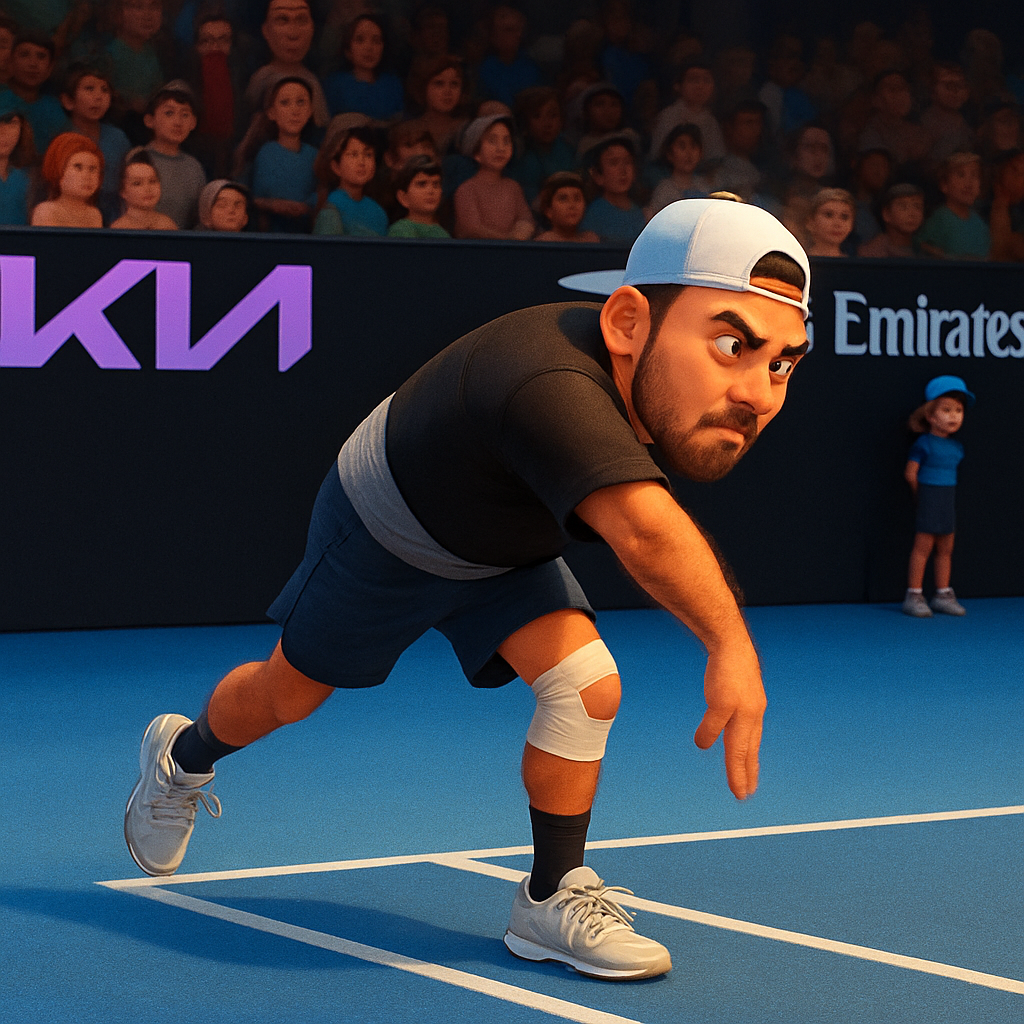
MELBOURNE — The combustible brilliance of Nick Kyrgios was on full, fiery display at the Australian Open, but not in the way fans had hoped. In a dramatic third-round clash against World No. 2 Daniil Medvedev, Kyrgios’s campaign ended in a signature meltdown, featuring a launched racket, a screaming tirade at the chair umpire, and a cascade of code violations that culminated in a point penalty on match point.
A Tense Battle Erupts into Chaos
The match itself was a high-quality, tense affair under the lights of Rod Laver Arena. Kyrgios, riding a wave of home support, pushed the reigning US Open champion to the limit, taking the first set in a tiebreak and engaging in thrilling, physical rallies. However, the pressure of the moment and Medvedev’s relentless, error-averse game began to wear on the Australian. The flashpoint came late in the fourth set, with Medvedev serving for the set at 5-4. After a grueling point ended with a Medvedev winner, Kyrgios’s frustration boiled over.
In full view of the capacity crowd, Kyrgios spiked his Yonex racket into the blue hard court with such force that it bounced high into the air and skidded towards the back fence. The act drew an immediate code violation for racket abuse from chair umpire Renaud Lichtenstein, Kyrgios’s second of the match following an earlier warning for an audible obscenity. This triggered a furious reaction from the 27-year-old, who unleashed a verbal barrage at the official.
"What is unsportsmanlike?" Kyrgios screamed, gesturing wildly. "He's (Medvedev) doing the same thing! Are you stupid? What are you doing? Bro, you are taking the fun out of it, for real." The tirade continued as Lichtenstein attempted to calm the situation, with Kyrgios adding, "You’re a disgrace. An absolute disgrace."
The Costly Consequences
The second code violation meant an automatic point penalty. Because the incident occurred at 15-0 in the game, Medvedev was awarded the next point to make it 30-0, placing him just two points from sealing the set. Visibly incensed, Kyrgios barely engaged in the next two points, effectively conceding the game and the set to Medvedev, leveling the match at two sets apiece. The crowd, initially fully behind their home hope, was left in a stunned silence mixed with murmurs of disapproval.
The momentum had irrevocably shifted. Kyrgios, still fuming during the changeover, received a third code violation early in the fifth set for another audible obscenity. Under Grand Slam rules, a third violation brings a game penalty. This handed Medvedev a crucial break at 1-1 in the decider, a deficit from which Kyrgios could not recover. The final, ignominious act came on match point. After receiving a time violation for taking too long to serve, Kyrgios, under the "fourth strike" rule, was assessed a point penalty, which ended the match on a technicality. Medvedev advanced 6-7(4), 6-4, 6-2, 4-6, 6-2.
A Cascade of Violations
The match's disciplinary timeline highlights how Kyrgios’s emotions unraveled his challenge:
• First Violation (Second Set): Warning for an audible obscenity.
• Second Violation (Fourth Set): Point penalty for racket abuse, sparking the umpire argument.
• Third Violation (Fifth Set): Game penalty for another audible obscenity, gifting a break.
• Fourth Violation (Fifth Set, Match Point): Point penalty for a time violation, ending the contest.
Post-Match Reactions and Regret
In his post-match press conference, a more subdued Kyrgios expressed regret for his actions, particularly their impact on his team and supporters. "I'm obviously very emotional. I wear my heart on my sleeve. I just feel like it was a bit of a letdown from myself," he admitted. "I'm human. Things like that happen. I was just really frustrated the way I was treated out there. I just felt like it wasn't fair." He also confirmed he had been fined $7,500 for the racket abuse incident, a sum that would be deducted from his tournament earnings.
Medvedev, who has had his own fiery moments with officials, took a diplomatic stance. "I always say we are all humans. We can get emotional. I can get emotional sometimes," the Russian stated. "For sure, he lost a little bit his nerve. That helped me a little bit, for sure, in this match. But that's part of the game." Tennis pundits and former players were divided in their analysis, with some criticizing the lack of control and respect for the game, while others argued it was simply part of the Kyrgios package—a raw talent whose emotions are inextricably linked to his explosive game.
The Broader Kyrgios Narrative
The incident immediately reignited the perennial debate about Kyrgios’s place in the sport. Just months prior, he had been celebrated for a mature and sensational run to the Wimbledon final, showcasing a focused and disciplined version of himself. The Australian Open, however, was a stark return to the volatility that has defined much of his career. The meltdown overshadowed the undeniable quality of tennis he produced for large stretches against one of the world's best players, raising familiar questions about what he could achieve with sustained composure.
The ATP’s rules are clear on the progression of penalties, and chair umpire Lichtenstein applied them by the book. However, the episode also highlighted the immense pressure on officials in high-stakes matches involving combustible personalities. The fine, while significant, is unlikely to deter future outbursts, leading to calls from some quarters for more severe sanctions, including potential suspensions, for repeated behavioral breaches.
For Kyrgios, the aftermath is one of reflection and damage control. In a social media post the following day, he thanked his fans and acknowledged the journey, writing, "I gave you all I had. The highs and lows, the fire and the ice. It’s me. I’ll be back." The Australian Open exit serves as another dramatic chapter in his complex story—a reminder of his capacity to electrify and exasperate, often within the same game. As the tennis world moves on, the hope for Kyrgios remains that his prodigious skill, not his temper, will ultimately write the defining passages of his career.