
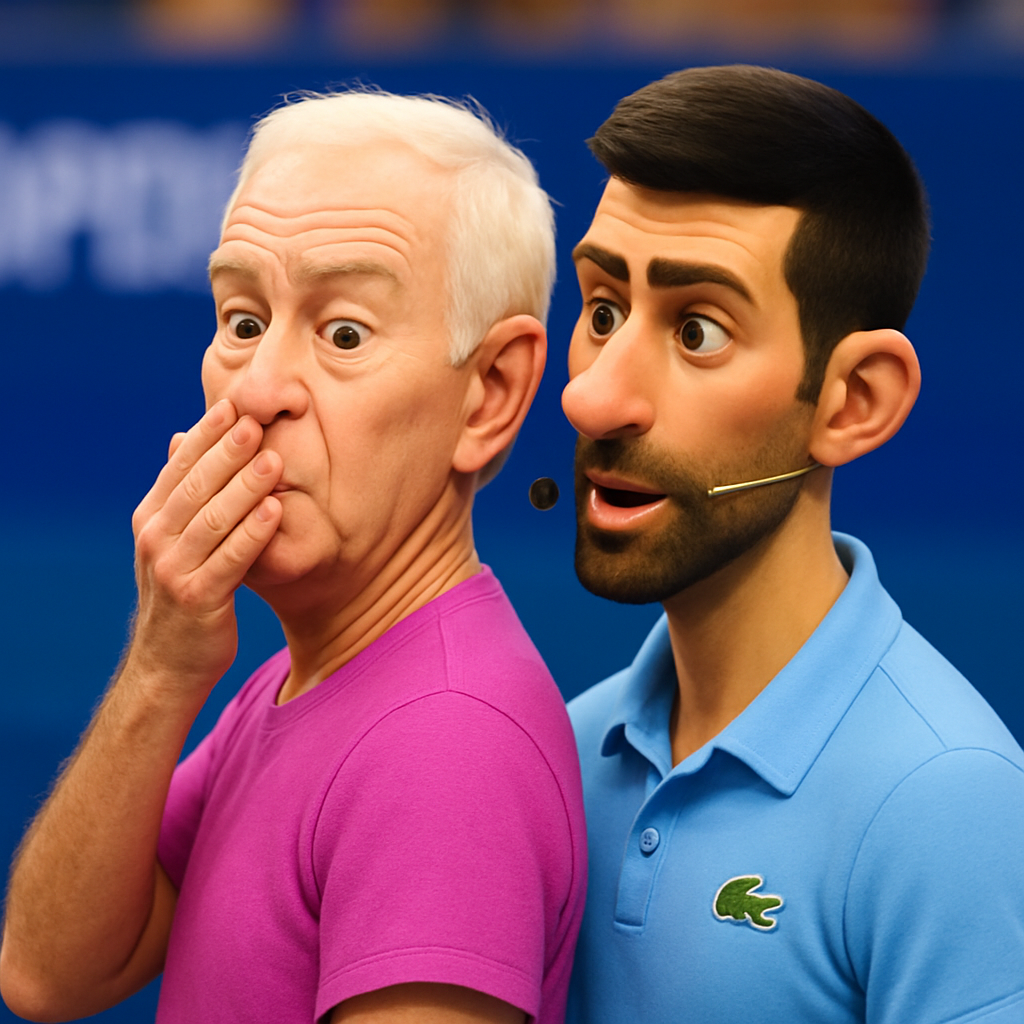
LONDON — The tennis world's ongoing debate over player representation and governance has found a new, vocal participant. John McEnroe, the sport's iconic and often outspoken former champion, has weighed in on Novak Djokovic's Professional Tennis Players Association (PTPA), revealing a telling split among the "Big Three." In recent comments, McEnroe highlighted how Rafael Nadal and Roger Federer have notably refused to back Djokovic's breakaway movement, choosing instead to remain aligned with the traditional governing bodies.
The PTPA: Djokovic's Lonely Crusade
Since its formation in 2020, the PTPA, co-founded by Novak Djokovic and Vasek Pospisil, has positioned itself as an independent body focused solely on protecting and advancing the interests of professional tennis players. Its stated mission is to give players, particularly those outside the top echelons, a genuine collective voice on issues ranging from prize money distribution and tournament schedules to pension plans and healthcare. However, the venture has been met with resistance from the ATP and WTA tours, which view it as a destabilizing force. More significantly, it has failed to garner the support of Djokovic's greatest rivals. McEnroe pointedly observed, "It's fascinating that the two guys who were his main rivals, Federer and Nadal, have not supported him. That tells you something."
McEnroe Picks Sides in the Governance Battle
In an interview with ESPN, McEnroe did not hold back in his analysis. While acknowledging the validity of some player grievances, he expressed skepticism about the PTPA's approach and outright questioned the absence of Nadal and Federer. "You've got the two most respected players of all time, arguably, who are saying, 'We're not buying into this,'" McEnroe stated. His comments underscore a fundamental rift: Djokovic's push for a radical restructuring of player power versus the more reform-minded stance of Nadal and Federer, who have historically worked within the existing ATP Player Council framework.
McEnroe elaborated on the practical hurdles facing the PTPA, noting the complexity of uniting both men and women across separate tours. He suggested that the lack of a unified front from the sport's biggest stars has severely hampered the association's momentum. "When you have a guy like Novak, who is one of the all-time greats, if he can't get the other top guys to go with him, it's an uphill battle," McEnroe conceded. His perspective aligns with the public record; both Nadal and Federer have consistently advocated for unity, with Nadal previously calling for the tennis family to "work together" and Federer emphasizing the importance of the ATP as the "right place" to discuss player issues.
The Stance of the "Silent" Rivals
The refusal of Nadal and Federer to endorse the PTPA is not a matter of mere personal disagreement but a strategic stance rooted in their view of the sport's ecosystem. Their concerns, as inferred from past statements, typically center on:
- Fragmentation: Fear that a separate union could create conflict and weaken the sport's overall structure.
- Existing Channels: Belief that the ATP Player Council, on which both have served, is the appropriate forum for change.
- Legacy and Stability: A desire to preserve the tours that nurtured their careers and ensure stability for future generations.
This philosophical divide was crystallized in 2020 when the PTPA was first announced during the US Open. The ATP, then led by President Andrea Gaudenzi, issued a statement strongly opposing the move, and Nadal and Federer quickly took to social media to express their solidarity with the tour, effectively isolating Djokovic in that pivotal moment.
The Core Conflict: Revolution vs. Reform
At its heart, the disagreement reflects two opposing theories of change. Djokovic's PTPA operates on the principle that true player empowerment requires a completely independent entity free from the influence of tournament directors and national federations that have seats on the ATP board. The association has scored some early wins, such as commissioning independent financial audits of tour operations and establishing a hardship fund for lower-ranked players. However, McEnroe's intervention highlights the persistent criticism: can it achieve meaningful change without the buy-in of the sport's other titans and its established institutions?
Conversely, the path favored by Nadal and Federer—and implicitly endorsed by McEnroe's analysis—is one of internal pressure and evolution. Their legacy is deeply intertwined with the ATP and its tournaments. The recent merger talks between the ATP and WTA, championed by Gaudenzi with public support from many top players (though notably with less vocal enthusiasm from Djokovic), exemplifies the reformist approach. This strategy seeks to strengthen the existing tours to better compete in the global sports market, theoretically raising all boats, rather than building a new vessel from scratch.
McEnroe's Verdict and the Road Ahead
While McEnroe expressed admiration for Djokovic's conviction, his commentary ultimately sided with the pragmatic concerns raised by Nadal and Federer's silence. He questioned the long-term viability of a separate union, especially in a sport with such a fragmented governance structure. "I understand what Novak is trying to do. I get it. The players should have more say," McEnroe said. "But you need everyone on board, and right now, it doesn't look like he has that."
The PTPA continues to operate, having elected a board and executive committee and expanding its membership. It positions itself as a "non-union trade association" and insists it is not seeking to replace the ATP or WTA but to serve as a complementary watchdog and advocate. Yet, as the sport moves forward with potential ATP-WTA merger discussions and new commercial ventures, the absence of its biggest active star and the public skepticism from legends like McEnroe presents a significant challenge.
The saga, as framed by McEnroe's recent remarks, is more than a simple power struggle. It is a clash of legacies and methodologies. Djokovic, often cast as the disruptor, seeks to cement his legacy not just with Grand Slam titles but with systemic change fought for from the outside. Nadal and Federer, the sport's elder statesmen, are protecting a system they believe can be improved from within. McEnroe, the fiery voice of a previous generation, has now placed himself squarely in the latter camp, using the unified front of Nadal and Federer as the ultimate evidence against Djokovic's solitary stand. As this governance battle quietly simmers alongside on-court competition, the alignment of tennis's most respected figures suggests that for now, the established order still holds the decisive advantage.