
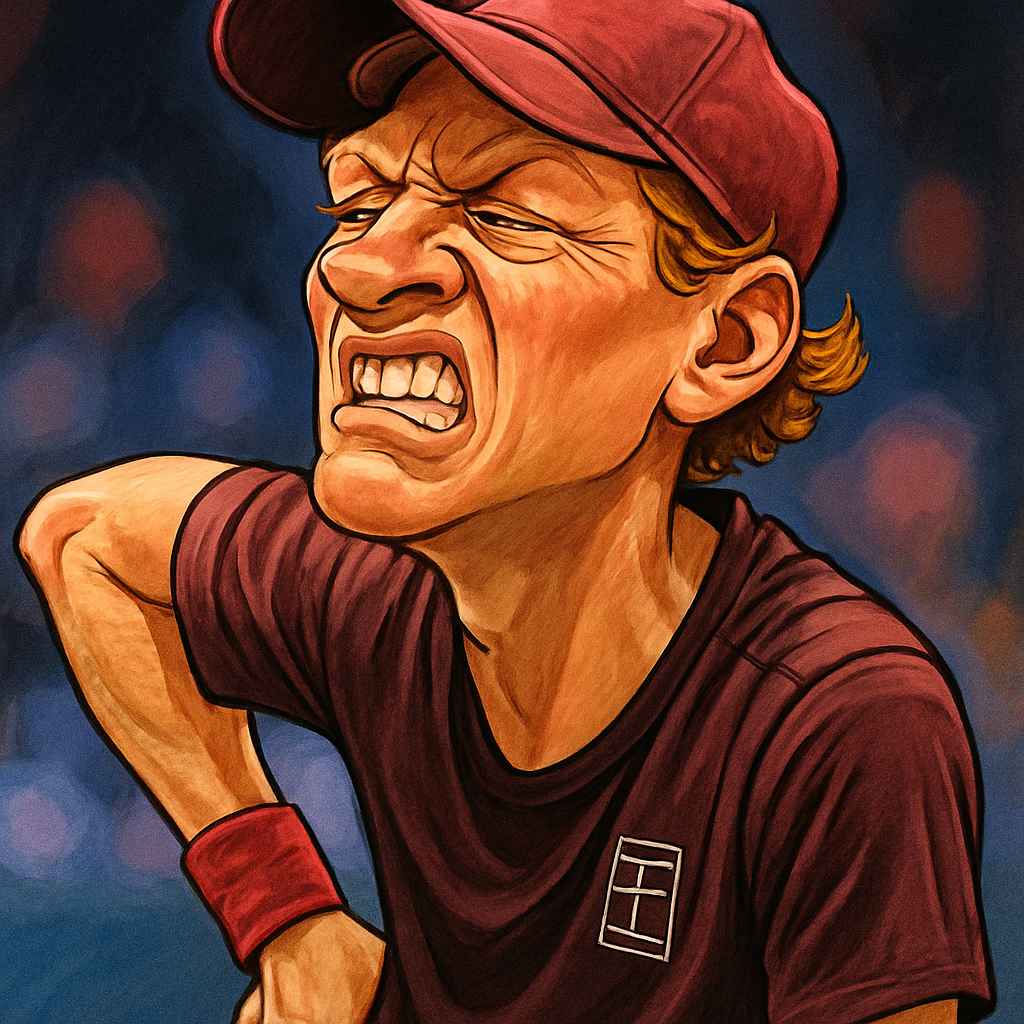
LONDON — Jannik Sinner navigated a tricky third-round encounter at Wimbledon on Friday, defeating Argentina's Francisco Cerundolo in four sets, 6-2, 6-2, 6-7(5), 6-3. However, the victory was overshadowed by visible signs of physical discomfort from the Australian Open champion, who later made a worrying statement about his condition and firmly rejected the idea of emulating the injury-management heroics of his rival, Carlos Alcaraz.
The top-seeded Italian seemed to be cruising, dictating play with his trademark powerful groundstrokes and securing a two-set lead with relative ease. The match's momentum shifted dramatically in the third set, not due to a surge from Cerundolo, but because of a noticeable decline in Sinner's movement and service speed. He was seen flexing his right hand and massaging his fingers, a clear indication that something was amiss.
A Victory Marred by Physical Concerns
Sinner’s discomfort became a central narrative of the match. His first-serve speed dropped significantly, and he struggled to generate his usual pace and spin on forehands. After dropping the third-set tiebreak, he received a medical timeout off the court at 2-1 in the fourth set, leaving fans on Centre Court in a state of suspense. Upon his return, he managed to break Cerundolo’s serve immediately and closed out the match, but the questions about his health were just beginning.
In his post-match press conference, Sinner was candid about the issue. "I was struggling a little bit," he admitted. "I think it was a physical problem. I wasn't feeling so good. I wasn't, let's say, 100%. I tried to fight with what I had today. I think for sure the third set was a little bit tactical, but at the same time, I didn't feel so good." When pressed for specifics, he pointed to his general physical state rather than a single, isolated injury.
Sinner's Firm Rejection of the "Alcaraz Approach" to Injuries
The conversation inevitably turned to the recent French Open, where Carlos Alcaraz battled a forearm issue throughout the tournament, using heavy strapping and still managing to lift the trophy. Journalists asked Sinner if he would consider taking a similar risk, playing through significant pain for the chance at glory. Sinner’s response was immediate and unequivocal, delivering a statement that will worry his fans and the tournament organizers.
"If I have a problem, I get the problem fixed. I don't want to take any risks," Sinner stated firmly. "I don't want to copy anyone. I'm quite careful about my body. We have a great team behind us that knows what's the best for me and my body. If there is any risk, I will not play. It's as simple as that."
This philosophy marks a stark contrast to the often-gritty "win at all costs" mentality seen in many champions. Sinner’s approach is methodical and long-term, prioritizing his career longevity over a single tournament. He elaborated on his cautious mindset, highlighting the potential consequences of ignoring warning signs from his body.
The Dangers of Playing Through Pain
Sinner’s refusal to "copy" Alcaraz is rooted in a pragmatic understanding of sports science and injury prevention. Playing through certain types of pain can transform a minor, manageable issue into a chronic, career-altering one. His team, which includes physiotherapists and fitness coaches, is famously meticulous in its planning and recovery protocols. Key risks Sinner is likely seeking to avoid include:
- Aggravating the Injury: Turning a strain into a tear.
- Altering Biomechanics: Compensating for pain can lead to secondary injuries in other parts of the body.
- Long-Term Damage: Risking long-term health for short-term gain.
This incident is not the first time Sinner has faced physical struggles at a major. He was forced to retire from his quarterfinal match at the 2022 French Open against Andrey Rublev and withdrew from the 2023 ATP Finals and the 2024 Madrid Open due to hip and hip/right knee issues, respectively. These past experiences have clearly shaped his current, ultra-cautious outlook.
The Road Ahead at Wimbledon
The immediate concern is Sinner's fourth-round match, where he is scheduled to face the big-serving American Ben Shelton or the Canadian Denis Shapovalov. Both are aggressive, left-handed players who will test Sinner's movement and reaction time to the limit. A less-than-100% Sinner becomes significantly more vulnerable against such powerful opponents.
When asked about his prospects for the next round, Sinner remained hopeful but non-committal, reiterating his cautious stance. "We'll see. We have now one day off, which can help me a lot to try to get better. I will talk with my team, with the doctors, and we will see what's the best thing to do. I'm very careful, remember."
The tennis world now holds its breath. Sinner, widely considered one of the two primary favorites for the title alongside Alcaraz, has introduced a major element of doubt into his campaign. His statement was not just about a single match; it was a declaration of a core principle that places health above immediate glory.
A Tale of Two Philosophies
The juxtaposition of Sinner's and Alcaraz's approaches to injury management presents a fascinating dichotomy in modern tennis. Alcaraz’s triumph in Paris, battling through visible discomfort, will be remembered as a legendary display of heart and grit. Sinner’s potential withdrawal, should his condition not improve, would be seen by his team as a necessary, intelligent decision to fight another day.
Neither approach is inherently right or wrong, but they reflect different risk tolerances and team philosophies. Sinner’s comments make it abundantly clear that he will not be swayed by external pressure or the example of his rivals. His body, and the long-term plan laid out by his team, will be the sole arbiters of his participation.
As the second week of Wimbledon begins, the focus will be intensely on the practice courts and the treatment room. The sight of Jannik Sinner hitting balls, the data on his serve speed, and the final decision from his team will be more consequential than any draw analysis. His worrying statement has turned his section of the draw into a question mark, a reminder that in a sport of supreme athleticism, the body always has the final say.