
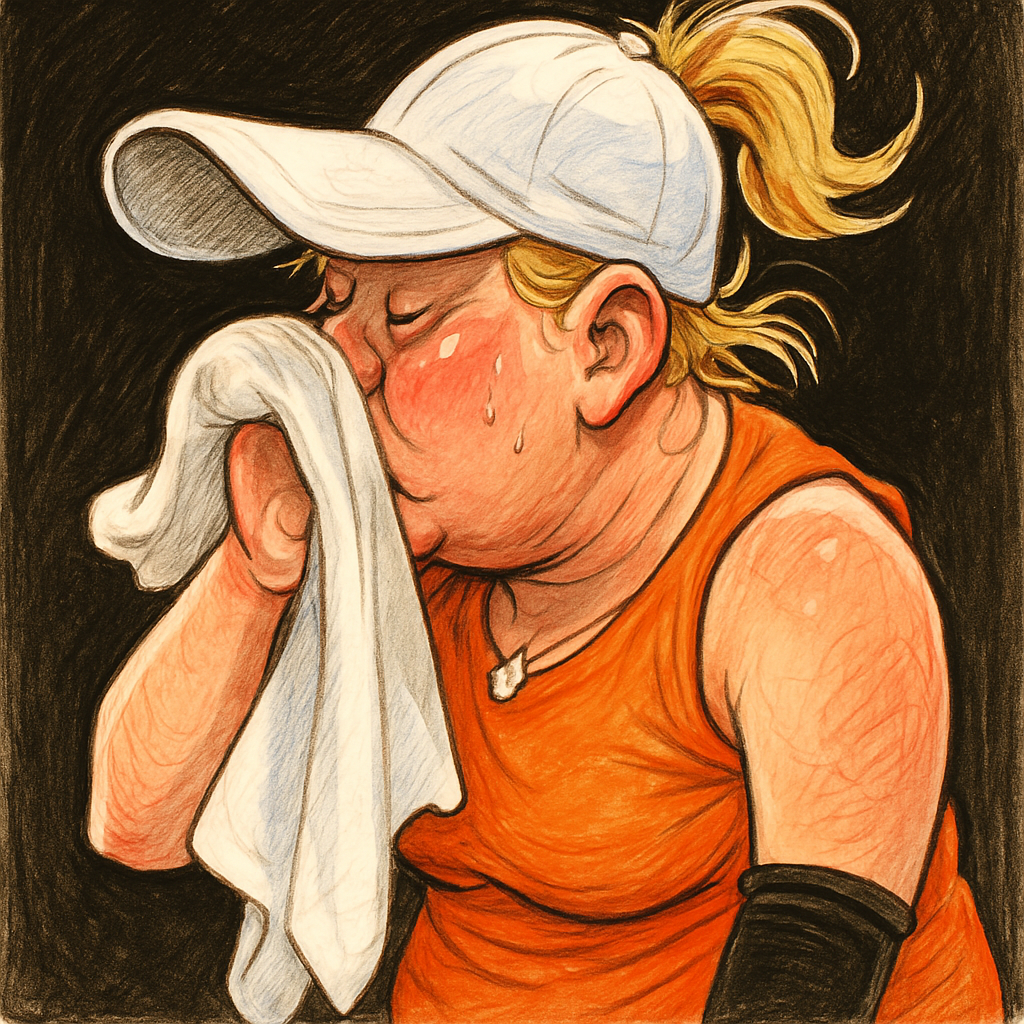
MELBOURNE — The opening days of a Grand Slam are often a festival of hope and new beginnings, but they also carry a brutal undercurrent of physical attrition. On a sweltering day two at the 2024 Australian Open, that reality was laid painfully bare as a spate of retirements and injuries overshadowed the on-court action, with two stories of heartbreak capturing the somber mood.
A Dream Deferred, Again, for Francesca Jones
For Britain’s Francesca Jones, the journey to Melbourne Park is a tale of resilience in itself. Born with a rare genetic condition, ectrodactyly ectodermal dysplasia, which left her with fewer fingers and toes than typical, her very presence in professional tennis is a triumph. Her hopes of a first main-draw win at the Australian Open, however, were shattered in cruel fashion on Court 3. Leading 5-2 in the first set against Romania’s Irina-Camelia Begu, Jones’s service motion suddenly betrayed her. A sharp pain in her serving shoulder forced her to take a medical timeout. She returned, but after dropping her serve and falling behind 0-30 in the next game, the 23-year-old from Leeds dissolved into tears, unable to continue.
In a raw and emotional post-match press conference, a sobbing Jones detailed the sudden onset of the injury. "I felt my shoulder, my serving shoulder, give way a little bit," she explained. "I just felt a really sharp pain. I knew at that point that it was going to be a struggle for me to serve. I tried to see if I could manage it, but I couldn't really lift my arm above my head." The physical pain was compounded by the acute disappointment of seeing a winning position vanish.
Overcoming More Than Most
Jones’s career has been a constant battle against the odds. Her condition affects her grip and balance, requiring immense adaptation. She has undergone multiple surgeries and faced constant questions about her viability in the sport. To qualify for Grand Slams, as she has done three times previously, represents a monumental achievement. This context made her emotional breakdown all the more poignant. "It's tough," she said, wiping away tears. "I'll pick myself up. I always do. It's just a shame that it had to happen here."
Her immediate future is uncertain, with scans pending to determine the severity of the shoulder issue. The incident highlighted the fragile line athletes walk, where a single, innocuous movement can unravel months of preparation and sacrifice.
A Wheelchair Exit for Canadian Teen Stakusic
If Jones’s exit was emotionally devastating, the scene on Court 12 was physically alarming. Canada’s 18-year-old qualifier Marina Stakusic, who had heroically helped her nation win the Billie Jean King Cup in November, was facing former world No. 1 Karolina Pliskova. After losing the first set 6-3, Stakusic began to struggle visibly with her movement. During a changeover, she received extensive treatment from the physio for what appeared to be a severe issue with her right leg or hip. Attempting to play on, she could barely push off to serve or move laterally.
The conclusion was distressing. After Pliskova held serve to lead 1-0 in the second set, Stakusic, in clear and debilitating pain, shook her head at her team. The chair umpire called for the trainer, and after a brief discussion, the teenager was helped into a wheelchair and escorted from the court, retiring from the match. The sight of a young player being wheeled out served as a stark reminder of the extreme physical demands of the sport.
While an official diagnosis was not immediately released, the nature of the exit suggested a potentially serious muscular or joint injury. For Stakusic, whose Melbourne campaign began with three qualifying wins, it was a brutal end to a promising breakthrough tournament. The physical toll of her deep qualifying run, coupled with the intensity of a main-draw match against a powerful hitter like Pliskova, may have proven too much.
A Day of Attrition Across the Grounds
Jones and Stakusic were not alone in their misfortune. The second day in Melbourne saw several players succumb to the conditions and the pressure of best-of-five-set tennis in the men's draw, and intense heat and humidity affecting all. The retirements painted a picture of a tournament already testing players' limits:
- Max Purcell (AUS): The local hope retired with a leg injury while down two sets to one against qualifier Mate Valkusz.
- Jan-Lennard Struff (GER): The powerful German retired due to a calf issue against Rinky Hijikata.
- Aleksandar Vukic (AUS): Another Australian, Vukic, was forced to retire with a foot injury against Jordan Thompson.
This cluster of mid-match exits reignites the ongoing debate in tennis about scheduling, the length of the season, and the specific physical toll of Grand Slam play. The Australian Open, coming after a short off-season, is particularly notorious for muscle-related injuries as players transition from practice intensity to competitive best-of-five sets.
The Human Cost of High Stakes
Beyond the statistics and the debate, day two was ultimately about human stories of shattered dreams. For Francesca Jones, the injury was a cruel interruption to a narrative defined by overcoming adversity. "I've worked so hard to be here," she reiterated, her voice cracking. "This is where I want to play. This is where I want to perform." Her vow to "pick myself up" resonates because her entire career is proof of her ability to do just that.
For Marina Stakusic, the abrupt end was a harsh lesson in the physical realities of the tour’s highest level. Her wheelchair exit is an image she and tennis fans will wish to forget, but it underscores the vulnerability of even the fittest athletes. The hope will be that her injury is not long-term, allowing her to build on her Billie Jean King Cup heroics later in the season.
As the tournament moves on, the victories will be celebrated and the headlines will follow the stars. Yet, the echoes of day two’s retirements serve as a sobering counterpoint. They remind us that for every champion who lifts a trophy, there are countless others whose campaigns end not with a handshake at the net, but with a sob on the bench or a silent ride in a wheelchair, their dreams deferred by the unforgiving demands of the sport they love.