
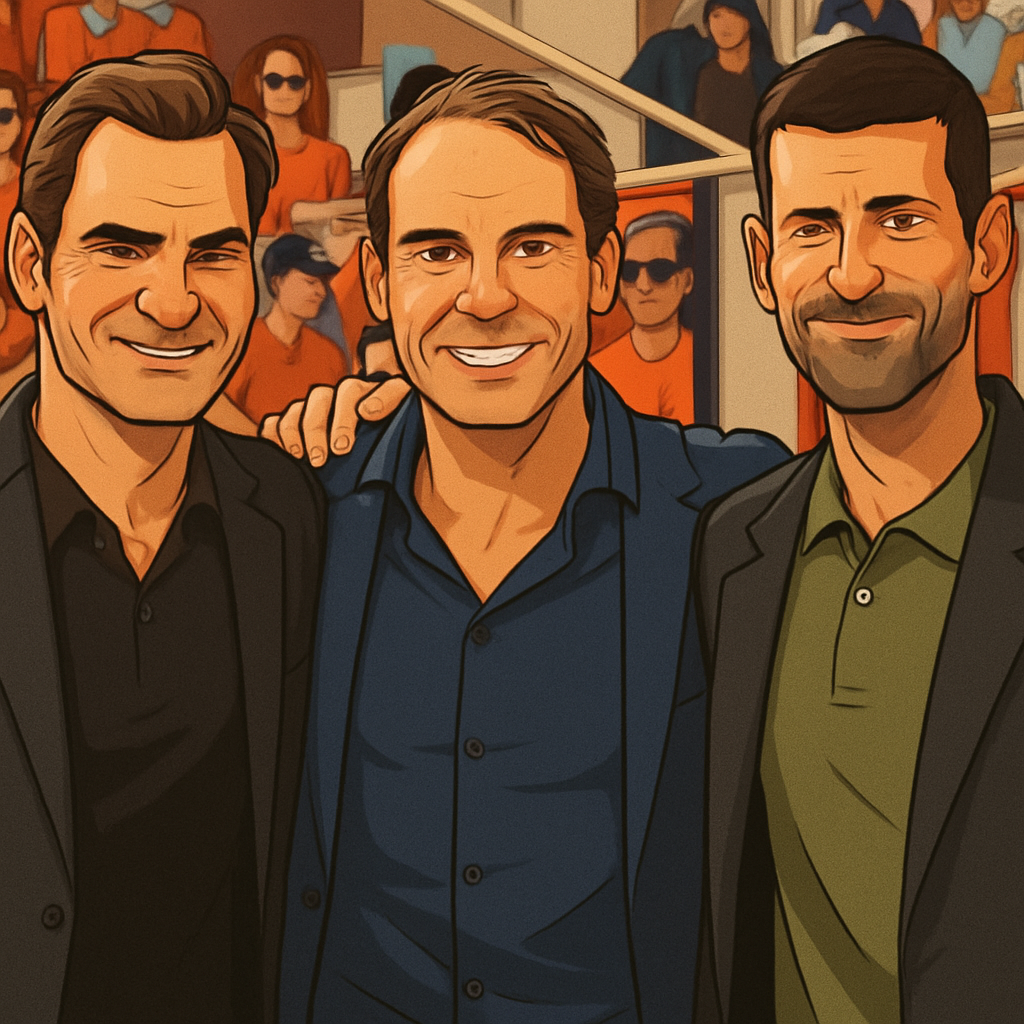
OPINION — In the golden era of men’s tennis, I was fortunate—or perhaps cursed—to have shared the court with the three defining champions of our sport: Roger Federer, Rafael Nadal, and Novak Djokovic. While fans and pundits endlessly debate their technical brilliance and trophy hauls, having faced them offers a unique, visceral perspective. From the other side of the net, you don't just see their forehands; you feel their aura, their pressure, and most crucially, their mental fortitude. And I can say without hesitation that one stands apart in the psychological battleground of the game.
The Artistry and the Ice: Facing Federer
Walking onto court against Roger Federer was an exercise in surreal admiration. His movement was effortless, his technique pristine. The mental challenge he presented was unique: it was the pressure of perfection. You knew he could hit winners from anywhere, that his serve would be a pinpoint scalpel, and that unforced errors were a rarity. The psychological game with Federer was one of inevitability. You had to believe you could disrupt a flawless machine. As the legendary Jimmy Connors once said, "In an era of specialists, you're either a clay court specialist, a grass court specialist, or a hard court specialist... or you're Roger Federer." This omnipresence was mentally draining before the first ball was struck.
The Relentless Storm: Confronting Nadal
If Federer was a swift, surgical defeat, Rafael Nadal was a war of physical and mental attrition. His intensity was a tangible force from the warm-up. Every point was a life-or-death scramble. The mental strength of Nadal is legendary and rooted in an unparalleled competitive fury. He makes you work for absolutely everything. You could construct the perfect point, hit what would be a winner against 99% of players, and he would not only retrieve it but transform it into an offensive opportunity. The psychological toll was cumulative. You started questioning your own game plan, wondering what more you could possibly do. His mindset is best captured by his own words: "My motivation is to be a better player today than I was yesterday, and a better one tomorrow than today." Against Rafa, you felt you were fighting that inexorable daily improvement in real time.
The Immovable Object: The Djokovic Phenomenon
Then there is Novak Djokovic. Competing against Novak is a distinct and profound psychological puzzle. While Federer imposed artistic perfection and Nadal unleashed relentless force, Djokovic projects an aura of impenetrable resilience. His mental strength is not just about fighting spirit; it's a cold, calculated, and unwavering belief that he will outlast you, out-think you, and absorb your best shot. In crucial moments—break points down, set points against him—his game elevates. This isn't a surge of emotion; it's a locking-in, a narrowing of focus that feels almost superhuman. The most daunting aspect is his ability to reset. You might win a grueling 45-shot rally, and on the very next point, he will chase down a drop shot as if the previous point never happened. There is no emotional hangover, no lapse. His mind is a fortress.
The Data Behind the Nerves
The statistics bear out what players feel on court. Djokovic's dominance in decisive moments is quantifiable and staggering:
- Match Points Saved: He has famously saved match points in Grand Slam matches and gone on to win the title multiple times, a feat of nerve unmatched in the sport's history.
- Deciding Set Record: His winning percentage in fifth sets and final-set tiebreaks is the highest in the Open Era, a direct reflection of his clutch mentality.
- Big Title Conversion: He holds the record for the most ATP Masters 1000 titles and has the highest win rate in finals of these major events alongside Grand Slams.
A Comparative Anatomy of Pressure
So, why does Djokovic edge out his two phenomenal rivals in this specific domain? It comes down to the source and application of their mental strength.
- Federer's strength was serene confidence, a flow state built on superior skill. When it was working, it was untouchable. But when challenged deeply—as Nadal and later Djokovic did—that flow could be disrupted, leading to uncharacteristic errors under duress.
- Nadal's is the ultimate competitive heart, a fire that burns on will and work ethic. It is perhaps the most inspiring form of mental strength. However, that intensity is also tied to his physicality; when his body has faltered, the fortress, while never surrendering, has shown gates.
- Djokovic's is different. It is a dispassionate, almost scientific mastery of the mind under pressure. He treats tension as a variable to be controlled, not a fire to be stoked or a river to flow with. It is detached, repeatable, and less dependent on aesthetics or raw physical peak.
This was never more evident than in the 2019 Wimbledon final, where he saved two championship points against Federer. While the entire Centre Court, and arguably the world, was emotionally willing Federer to victory, Djokovic existed in a vacuum of focus. He later described it as "trying to be in the moment and not think about the potential outcome." That ability to silence the roar of history, legacy, and crowd sentiment in the most pivotal second of a match is the purest form of mental strength I have ever witnessed.
Conclusion: The Ultimate Adversary
Facing Federer was a lesson in grace under pressure. Facing Nadal was a lesson in courage under fire. But facing Djokovic is a lesson in the very nature of pressure itself—he doesn't just withstand it; he dismantles it and uses it as fuel. His mental framework seems built for the singular purpose of winning tennis matches, unburdened by the need for stylistic approval or traditional rivalry narratives. In my experience, while all three are giants whose mental fortitude is light-years beyond the average player, Novak Djokovic possesses a specific, almost algorithmic brand of toughness that makes him the most mentally formidable opponent I have ever stood across. In the theater of the mind that is elite sport, he is the master playwright and the lead actor, completely in control of the drama, especially when the stakes are highest.