
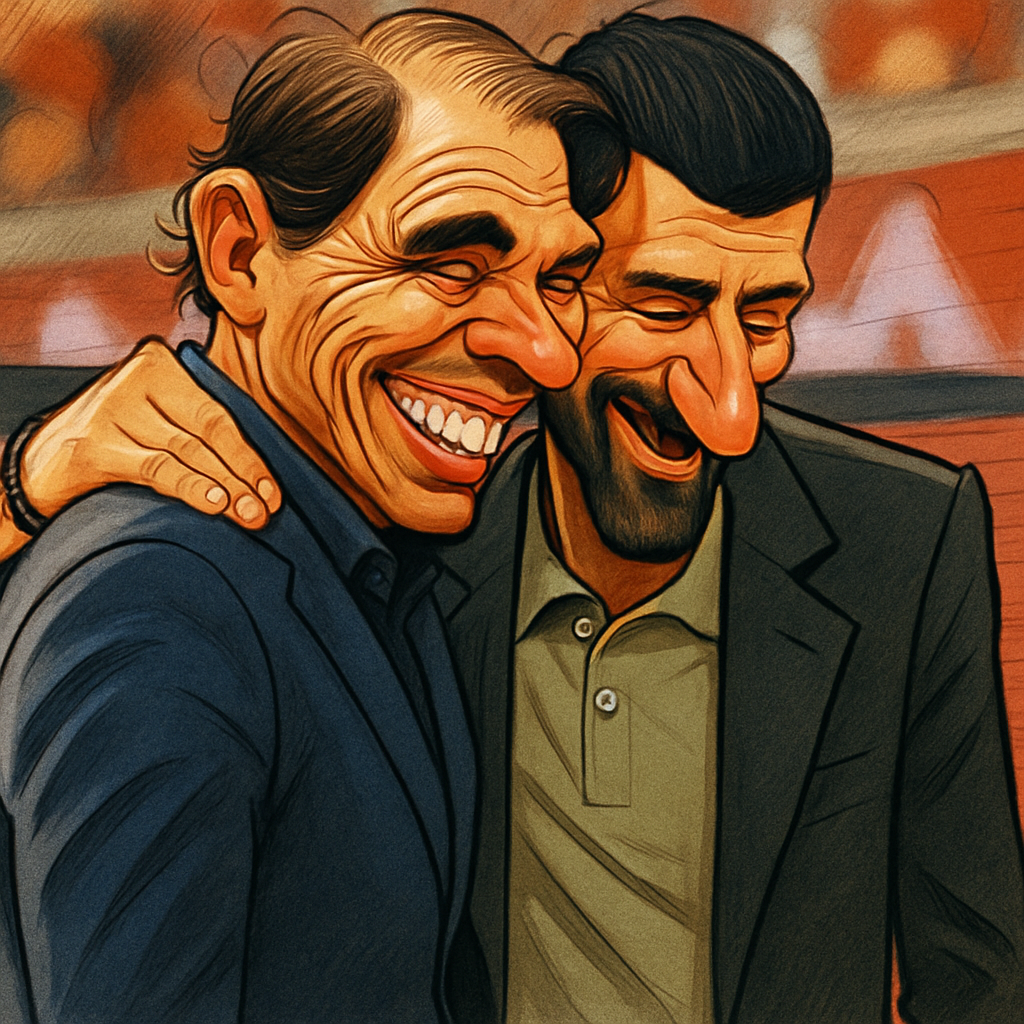
PARIS — The scene at Roland-Garros was one of raw, unfiltered emotion. Rafael Nadal, the undisputed King of Clay, stood on the court he has ruled for nearly two decades, his voice cracking as he addressed a packed, tearful Philippe-Chatrier court. In a poignant moment of sporting fraternity, his greatest rival, Novak Djokovic, was summoned to join him. The two legends embraced, a powerful image of respect forged in the furnace of 59 epic matches. As Nadal confirmed this was likely his final French Open, the question immediately turned to the man standing beside him. When will Novak Djokovic make the same announcement?
The answer, from those who know him best, is simple: not for a long time. While Nadal’s body, battered by years of superhuman exertion, has dictated the terms of his farewell, Djokovic operates on a different plane. His recent struggles—a semi-final loss here to an inspired Casper Ruud, a lack of a title in 2024, and visible frustration on court—have sparked speculation about his own decline. But to conflate a temporary dip with a career sunset is to profoundly misunderstand the psyche of the 24-time Grand Slam champion.
The Unyielding Mindset: More Than Just Tennis
To understand why Djokovic won’t follow Nadal into a valedictory tour anytime soon, one must look beyond forehands and backhands. His long-time coach, Marián Vajda, recently shed light on the engine that drives Djokovic. "Novak’s motivation has never been solely about trophies or records," Vajda stated. "It is about the pursuit of a higher state of performance, about mastering his own body and mind. He sees challenges not as obstacles, but as necessary fuel."
This mindset transforms a period of difficulty from a reason to retire into a puzzle to be solved. Where Nadal has spoken openly about the daily pain that saps his joy, Djokovic publicly frames his current situation as a technical and physical recalibration. After his Paris loss, he was clear: "I know I can play better. My body is telling me it needs more time to reach its peak."
The Physical Equation: Preservation Over Wear
Nadal’s career is a testament to glorious, relentless combat. His style, built on explosive, physically taxing movement, has exacted a heavy toll. Djokovic, while equally athletic, has built his longevity on a foundation of elasticity, flexibility, and almost scientific recovery. His commitment to biomechanical efficiency and holistic health is legendary. This fundamental difference in athletic wear-and-tear is critical:
- Preventative Regimen: Djokovic’s team focuses intensely on prehabilitation—preventing injuries before they occur through meticulous warm-ups, cutting-edge recovery technology, and a famously strict diet.
- Strategic Scheduling: He has mastered the art of peaking for Slams, often playing a lighter tour schedule than his rivals to preserve his body for the majors that define his legacy.
- Technical Economy: His game, built on flawless technique and balance, is inherently less punishing on his joints than Nadal’s ultra-physical style.
As former player and analyst Brad Gilbert noted, "Rafa’s war has been against his own physique for years. Novak’s war is different—it’s against history, against time, but he’s armed with a body he has curated like a Formula 1 car. The maintenance program is otherworldly."
The Goals That Remain Unchecked
Retirement whispers are loudest when motivation wanes. For Djokovic, the motivational checklist is far from complete. He is a man who publicly and privately sets towering objectives. The current landscape presents clear, tangible targets that will keep him hungry:
- The Golden Slam: The prospect of winning all four majors and Olympic gold in a single year—a feat never achieved by a man—is alive in 2024. Paris Olympics gold is a glaring omission from his resume and a burning desire.
- Separation at the Top: With 24 Slams, he leads Nadal by two and Roger Federer by four. The drive to extend that lead, to put the all-time record beyond conceivable reach, is a powerful force.
- Weeks at World No. 1: He already holds this record, but continuing to add to it reinforces his era of dominance.
"He talks about these goals openly in the team," revealed a source close to Djokovic’s camp. "They are not vague aspirations. They are plotted on a calendar. As long as they exist, and he believes his body can be tuned to attack them, he will play."
The Nadal Ceremony: A Catalyst, Not a Mirror
Watching Nadal’s emotional farewell did not trigger thoughts of his own exit in Djokovic; it likely had the opposite effect. For a competitor of his intensity, such a moment serves as a stark reminder of the finite nature of a career, yes, but also as a catalyst to squeeze every last drop from his own. He saw the outpouring of love for a warrior leaving the battlefield. For Djokovic, the battle continues. He has often been motivated by proving doubters wrong, and the current narrative of his "decline" is precisely the kind of fuel he has historically used to ignite a resurgence.
Conclusion: The Final Bell is Not Close
Rafael Nadal’s announcement was born from a painful acceptance of physical reality. Novak Djokovic’s eventual retirement will be a conscious, deliberate choice made from a position of strength, not surrender. He will not be ushered off the stage by a failing body or a dip in results. He will leave only when the ultimate goals are achieved or when the fire to chase them finally dims. That fire, fanned by history, legacy, and an unquenchable competitive thirst, still burns brightly. Do not expect a similar announcement from Novak Djokovic for years to come. The final chapter of his story is still being written, and he holds the pen.